


Order unit
An order unit is an element of an ordered vector space which can be used to bound all elements from above.[1] In this way (as seen in the first example below) the order unit generalizes the unit element in the reals.
According to H. H. Schaefer, "most of the ordered vector spaces occurring in analysis do not have order units."[2]
Definition
[edit]For the ordering cone in the vector space , the element is an order unit (more precisely a -order unit) if for every there exists a such that (that is, ).[3]




Equivalent definition
[edit]The order units of an ordering cone are those elements in the algebraic interior of that is, given by [3]


Examples
[edit]Let be the real numbers and then the unit element is an order unit.



Let and then the unit element is an order unit.


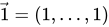
Each interior point of the positive cone of an ordered topological vector space is an order unit.[2]
Properties
[edit]Each order unit of an ordered TVS is interior to the positive cone for the order topology.[2]
If is a preordered vector space over the reals with order unit then the map is a sublinear functional.[4]



Order unit norm
[edit]Suppose is an ordered vector space over the reals with order unit whose order is Archimedean and let Then the Minkowski functional of defined by is a norm called the order unit norm. It satisfies and the closed unit ball determined by is equal to that is, [4]

![{\displaystyle U=[-u,u].}](https://wikimedia.org/api/rest_v1/media/math/render/svg/5c8817dc2c435d034966283761843fdd15b71dd1)


![{\displaystyle p_{U}(x):=\inf\{r>0:x\in r[-u,u]\},}](https://wikimedia.org/api/rest_v1/media/math/render/svg/cd2b2bd59e509d67c9bb28982c8f433b3ae751bb)

![{\displaystyle [-u,u];}](https://wikimedia.org/api/rest_v1/media/math/render/svg/25059e4bff4a4c53c7f82f1e50a18cd3da73462d)
![{\displaystyle [-u,u]=\left\{x\in X:p_{U}(x)\leq 1\right\}.}](https://wikimedia.org/api/rest_v1/media/math/render/svg/9d29074f112e21edb0c2570fc80b118e4fbb6fe6)
References
[edit]- ↑ Fuchssteiner, Benno; Lusky, Wolfgang (1981). Convex Cones. Elsevier. ISBN 9780444862907.
- 1 2 3 Schaefer & Wolff 1999, pp. 230–234.
- 1 2 Charalambos D. Aliprantis; Rabee Tourky (2007). Cones and Duality. American Mathematical Society. ISBN 9780821841464.
- 1 2 Narici & Beckenstein 2011, pp. 139–153.
Bibliography
[edit]- Narici, Lawrence; Beckenstein, Edward (2011). Topological Vector Spaces. Pure and applied mathematics (Second ed.). Boca Raton, FL: CRC Press. ISBN 978-1584888666. OCLC 144216834.
- Schaefer, Helmut H.; Wolff, Manfred P. (1999). Topological Vector Spaces. GTM. Vol. 8 (Second ed.). New York, NY: Springer New York Imprint Springer. ISBN 978-1-4612-7155-0. OCLC 840278135.
| Spaces |
| ||||
|---|---|---|---|---|---|
| Theorems | |||||
| Operators | |||||
| Algebras | |||||
| Open problems | |||||
| Applications | |||||
| Advanced topics | |||||
