


// Workers AI · dad joke modeWhat did bivariant theory say to its date? You vary, I vary.
 | This article includes a list of references, related reading, or external links, but its sources remain unclear because it lacks inline citations. (October 2025) |
In mathematics, a bivariant theory was introduced by Fulton and MacPherson (Fulton & MacPherson 1981), in order to put a ring structure on the Chow group of a singular variety, the resulting ring called an operational Chow ring.
On technical levels, a bivariant theory is a mix of a homology theory, specifically Borel-Moore homology, and a cohomology theory.[1] In general, a homology theory is a covariant functor from the category of spaces to the category of abelian groups, while a cohomology theory is a contravariant functor from the category of (nice) spaces to the category of rings. A bivariant theory is a functor both covariant and contravariant; hence, the name “bivariant”.
Definition
[edit]Unlike a homology theory or a cohomology theory, a bivariant class is defined for a map not a space.
Let be a map. For such a map, we can consider the fiber square

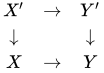
(for example, a blow-up.) Intuitively, the consideration of all the fiber squares like the above can be thought of as an approximation of the map .

Now, a birational class of is a family of group homomorphisms indexed by the fiber squares:

satisfying the certain compatibility conditions.
Operational Chow ring
[edit]![[icon]](/everything/wiki/File:Wiki_letter_w_cropped.svg) | This section needs expansion. You can help by adding missing information. (October 2019) |
The basic question was whether there is a cycle map:

If X is smooth, such a map exists since is the usual Chow ring of X. (Totaro 2014) has shown that rationally there is no such a map with good properties even if X is a linear variety, roughly a variety admitting a cell decomposition. He also notes that Voevodsky's motivic cohomology ring is "probably more useful" than the operational Chow ring for a singular scheme (§ 8 of loc. cit.)

References
[edit]- ↑ Abe, Tomoyuki (2022). "Enhanced bivariant homology theory attached to six functor formalism". Journal of Topology. 15 (4): 1675–1754. doi:10.1112/topo.12249. ISSN 1753-8424.
- Totaro, Burt (1 June 2014). "Chow groups, Chow cohomology, and linear varieties". Forum of Mathematics, Sigma. 2 e17. doi:10.1017/fms.2014.15.
- Dan Edidin and Matthew Satriano, Towards an intersection Chow cohomology for GIT quotients
- Fulton, William (1998), Intersection Theory, Berlin, New York: Springer-Verlag, ISBN 978-0-387-98549-7, MR 1644323
- Fulton, William; MacPherson, Robert (1981). Categorical Framework for the Study of Singular Spaces. American Mathematical Soc. ISBN 978-0-8218-2243-2.
- The last two lectures of Vakil, Math 245A Topics in algebraic geometry: Introduction to intersection theory in algebraic geometry