


Omnitruncation
In geometry, an omnitruncation of a convex polytope is a simple polytope of the same dimension, having a vertex for each flag of the original polytope and a facet for each face of any dimension of the original polytope. Omnitruncation is the dual operation to barycentric subdivision.[1] Because the barycentric subdivision of any polytope can be realized as another polytope,[2] the same is true for the omnitruncation of any polytope.
When omnitruncation is applied to a regular polytope (or honeycomb) it can be described geometrically as a Wythoff construction that creates a maximum number of facets. It is represented in a Coxeter–Dynkin diagram with all nodes ringed.


It is a shortcut term which has a different meaning in progressively-higher-dimensional polytopes:
- Uniform polytope truncation operators
- For regular polygons: An ordinary truncation, .
- For uniform polyhedra (3-polytopes): A cantitruncation, . (Application of both cantellation and truncation operations)
- Coxeter-Dynkin diagram:


- Coxeter-Dynkin diagram:
- For uniform polychora: A runcicantitruncation, . (Application of runcination, cantellation, and truncation operations)
- Coxeter-Dynkin diagram:
 ,
, 
 ,
, 
- Coxeter-Dynkin diagram:
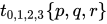
- For uniform polytera (5-polytopes): A steriruncicantitruncation, t0,1,2,3,4{p,q,r,s}. . (Application of sterication, runcination, cantellation, and truncation operations)
- Coxeter-Dynkin diagram:
 , ,
, , 

- Coxeter-Dynkin diagram:
- For uniform n-polytopes: .




See also
[edit]References
[edit]- ↑ Matteo, Nicholas (2015), Convex Polytopes and Tilings with Few Flag Orbits (Doctoral dissertation), Northeastern University, ProQuest 1680014879 See p. 22, where the omnitruncation is described as a "flag graph".
- ↑ Ewald, G.; Shephard, G. C. (1974), "Stellar subdivisions of boundary complexes of convex polytopes", Mathematische Annalen, 210: 7–16, doi:10.1007/BF01344542, MR 0350623
Further reading
[edit]- Coxeter, H.S.M. Regular Polytopes, (3rd edition, 1973), Dover edition, ISBN 0-486-61480-8 (pp. 145–154 Chapter 8: Truncation, p 210 Expansion)
- Norman Johnson Uniform Polytopes, Manuscript (1991)
- N.W. Johnson: The Theory of Uniform Polytopes and Honeycombs, Ph.D. Dissertation, University of Toronto, 1966
External links
[edit]| Seed | Truncation | Rectification | Bitruncation | Dual | Expansion | Omnitruncation | Alternations | ||
|---|---|---|---|---|---|---|---|---|---|
  |
 |
|
|
|
|
|
 |
|
|
 |
 |
 |
 |
 |
 |
 |
 |
 |
 |
| t0{p,q} {p,q} |
t01{p,q} t{p,q} |
t1{p,q} r{p,q} |
t12{p,q} 2t{p,q} |
t2{p,q} 2r{p,q} |
t02{p,q} rr{p,q} |
t012{p,q} tr{p,q} |
ht0{p,q} h{q,p} |
ht12{p,q} s{q,p} |
ht012{p,q} sr{p,q} |