


Normal cone (convex analysis)
In convex analysis and optimization, the normal cone to a set at a point is a convex cone consisting of vectors that make a non-acute angle with every feasible direction from the point. For a convex set, it is the polar cone of the tangent cone and gives a geometric form of first-order optimality conditions.[1][2]
Definition
[edit]Let be a convex subset of a finite-dimensional real inner product space , and let . The normal cone to at is


If , the normal cone is often defined to be empty. The elements of are called normal vectors to at . The sign convention above gives outward normals.


If is an interior point of , then . If is a smooth full-dimensional convex body and is a boundary point, then is the ray generated by the outward normal vector at .
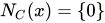
Subgradients
[edit]Normal cones are closely related to subgradients. If is a proper convex function, then its epigraph is a convex set. A vector is a subgradient of at if and only if[1][3]


Equivalently,

Sublevel sets
[edit]Still with a proper convex function, consider the sublevel set through a point : Every subgradient of at determines a normal vector to at . Indeed, if and , then


Under standard regularity hypotheses, for example when and is not a minimizer of , the converse also holds: or equivalently the normal cone to the sublevel set is the closed convex cone generated by the subdifferential.[1][4]


Notes
[edit]References
[edit]- Borwein, Jonathan M.; Lewis, Adrian S. (2006), Convex Analysis and Nonlinear Optimization: Theory and Examples (2nd ed.), New York: Springer, ISBN 978-0-387-29570-1.
- Boyd, Stephen; Vandenberghe, Lieven (2004), Convex Optimization, Cambridge University Press, ISBN 978-0-521-83378-3.
- Rockafellar, R. Tyrrell (1970), Convex Analysis, Princeton Mathematical Series, vol. 28, Princeton University Press, ISBN 978-0-691-08069-7.
- Rockafellar, R. Tyrrell; Wets, Roger J.-B. (1998), Variational Analysis, Grundlehren der mathematischen Wissenschaften, vol. 317, Springer, ISBN 978-3-540-62772-2.