// Workers AI · dad joke modeWhat did NGC 3003 say to NGC 3004? You're a galaxy ahead.
| NGC 3003 | |
|---|---|
 SDSS image of NGC 3003 | |
| Observation data (J2000 epoch) | |
| Constellation | Leo Minor[1] |
| Right ascension | 09h 48m 35.580s[2] |
| Declination | +33° 25′ 17.83″[2] |
| Redshift | 0.004930[2] |
| Heliocentric radial velocity | 1,474 km/s[2] |
| Distance | 63.6 Mly (19.50 Mpc)[3] |
| Apparent magnitude (V) | 11.78[4] |
| Apparent magnitude (B) | 12.25[4] |
| Characteristics | |
| Type | SBbc[4] |
| Apparent size (V) | 5.7′ × 1.4′[1] |
| Other designations | |
| UGC 5251, MCG +06-22-013, PGC 28186[2] | |
NGC 3003 is a nearly edge-on barred spiral galaxy in the constellation of Leo Minor,[1] discovered by German-British astronomer William Herschel on December 7, 1785.[5] It has an apparent visual magnitude of 11.78,[4] and spans an angular size of 5.7′ × 1.4′.[1] NGC 3003 is located at a distance of 19.5 Mpc from the Sun,[3] with a recessional velocity of 1,474 km/s.[2]
The morphological classification of NGC 3003 is SBbc,[4] indicating a barred spiral (SB) with moderate to loosely wound spiral arms (bc). The shape of the galaxy suggests it has been disturbed, possibly by NGC 3021. The two have a projected separation of about 200 kpc. NGC 3003 displays high luminosity in the hydrogen-alpha line, showing a bright nucleus and many prominent H II regions.[6] 25 independent star forming regions have been identified, including the nuclear region. There is a bright and compact region to the southwest, which may be the remains of a dwarf galaxy or an intense H II region.[7]
Supernova and luminous blue variable
[edit]
One supernova and one luminous blue variable have been observed in NGC 3003:
References
[edit]- 1 2 3 4 Finlay, Warren H. (2014). Concise Catalogue of Deep-Sky Objects. The Patrick Moore Practical Astronomy Series (2nd ed.). Springer Cham. p. 234. doi:10.1007/978-3-319-03170-5. ISBN 978-3-319-03169-9.
- 1 2 3 4 5 6 "NGC 3003". SIMBAD. Centre de données astronomiques de Strasbourg. Retrieved 2021-02-10.
- 1 2 Tully, R. Brent; Courtois, Hélène M.; Sorce, Jenny G. (2016). "Cosmicflows-3". The Astronomical Journal. 152 (2): 21. arXiv:1605.01765. Bibcode:2016AJ....152...50T. doi:10.3847/0004-6256/152/2/50. S2CID 250737862. 50.
- 1 2 3 4 5 "Search specification: NGC 3003". HyperLeda. Université Claude Bernard Lyon 1. Retrieved 2021-02-10.
- ↑ Seligman, Courney. "New General Catalog Objects: NGC 3000 - 3049". Celestial Atlas. Retrieved 2026-08-27.
- ↑ Hoopes, Charles G.; et al. (September 1999). "Diffuse Ionized Gas in Edge-on Spiral Galaxies: Extraplanar and Outer Disk Hα Emission". The Astrophysical Journal. 522 (2): 669–685. arXiv:astro-ph/9904154. Bibcode:1999ApJ...522..669H. doi:10.1086/307670.
- ↑ Karthick, M. Chrisphin; et al. (March 2014). "Photometric and spectroscopic studies of star-forming regions within Wolf-Rayet galaxies". Monthly Notices of the Royal Astronomical Society. 439 (1): 157–178. arXiv:1311.7504. Bibcode:2014MNRAS.439..157K. doi:10.1093/mnras/stt2301.
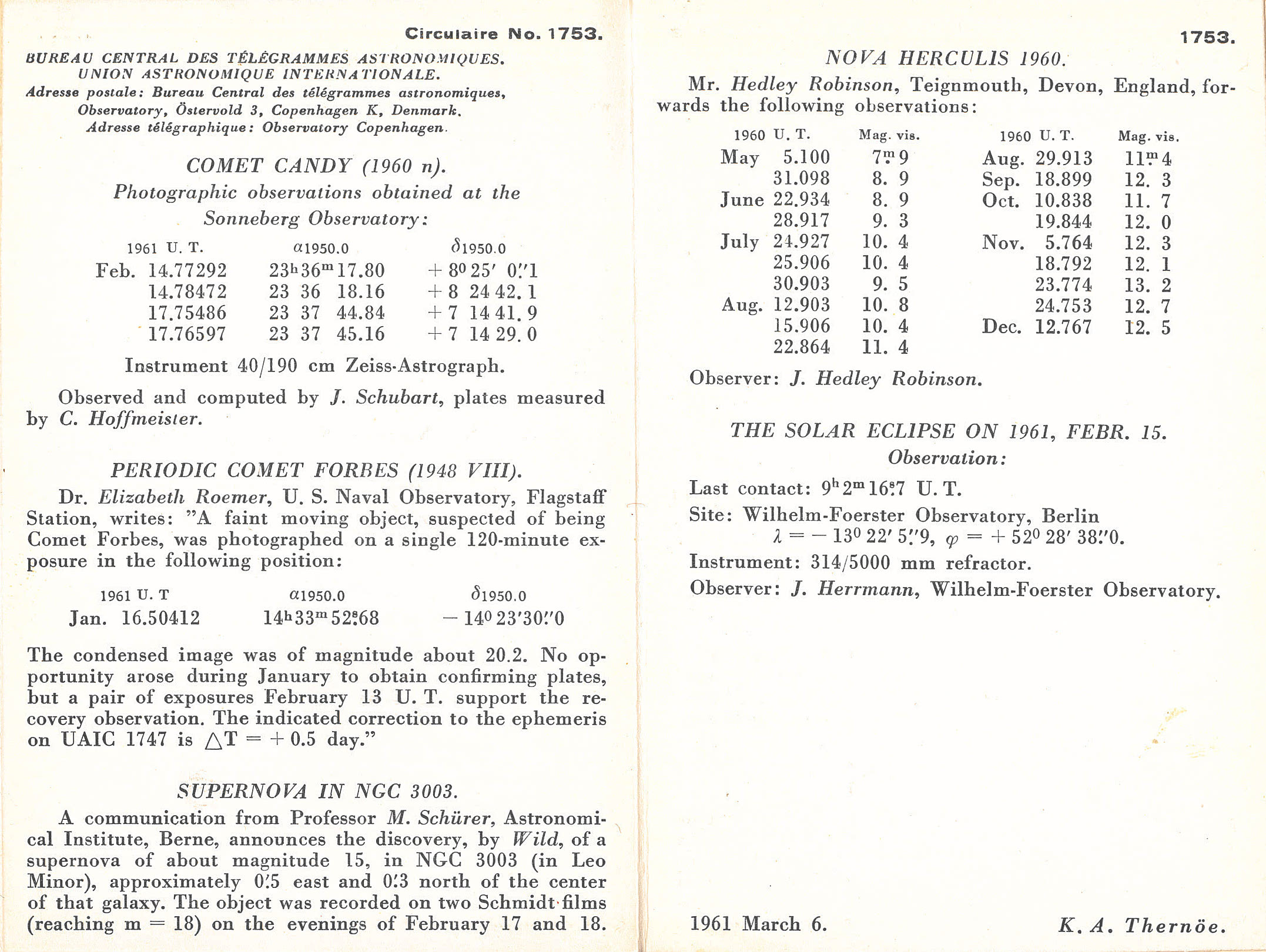
- ↑ Schürer, M.; Wild (6 March 1961). Thernöe, K. A. (ed.). "SUPERNOVA IN NGC 3003". Central Bureau for Astronomical Telegrams. 1753. Observatory Copenhagen, IAU: 1. Retrieved 30 November 2024.
- ↑ "SN 1961F". SIMBAD. Centre de données astronomiques de Strasbourg. Retrieved 2021-02-10.
- ↑ "SN 1961F". Transient Name Server. IAU. Retrieved 30 November 2024.
- ↑ "AT 2020jev". Transient Name Server. IAU. Retrieved 25 May 2026.
- ↑ Siebert, M. R.; Tinyanont, S.; Taggart, K.; Foley, R. J. (2021). "Spectroscopic Classifications of Optical Transients with the Keck I telescope". The Astronomer's Telegram. 14624: 1. Bibcode:2021ATel14624....1S.
External links
[edit] Media related to NGC 3003 at Wikimedia Commons