


Morphological gradient
In mathematical morphology and digital image processing, a morphological gradient is the difference between the dilation and the erosion of a given image. It is an image where each pixel value (typically non-negative) indicates the contrast intensity in the close neighborhood of that pixel. It is useful for edge detection and segmentation applications.
Mathematical definition and types
[edit]Let be a grayscale image, mapping points from a Euclidean space or discrete grid E (such as R2 or Z2) into the real line. Let be a grayscale structuring element. Usually, b is symmetric and has short-support, e.g.,


- .
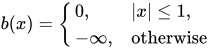
Then, the morphological gradient of f is given by:
- ,

where and denote the dilation and the erosion, respectively.


An internal gradient is given by:
- ,

and an external gradient is given by:
- .

The internal and external gradients are "thinner" than the gradient, but the gradient peaks are located on the edges, whereas the internal and external ones are located at each side of the edges. Notice that .

If , then all the three gradients have non-negative values at all pixels.

References
[edit]- Image Analysis and Mathematical Morphology by Jean Serra, ISBN 0-12-637240-3 (1982)
- Image Analysis and Mathematical Morphology, Volume 2: Theoretical Advances by Jean Serra, ISBN 0-12-637241-1 (1988)
- An Introduction to Morphological Image Processing by Edward R. Dougherty, ISBN 0-8194-0845-X (1992)
External links
[edit]- Morphological gradients, Centre de Morphologie Mathématique, École_des_Mines_de_Paris
 | This computer graphics–related article is a stub. You can help Wikipedia by adding missing information. |
 | This computer science article is a stub. You can help Wikipedia by adding missing information. |