Cloudflare fetched the original article and streamed it through HTMLRewriter to apply an entirely new visual system without rebuilding the source page.
// request.cf · coarse context
A page that knows where it met you.
Only coarse request metadata is shown. This demo does not display or persist visitor IP addresses.
This article is about coded aperture masks. For other uses, see Mura.
A modified uniformly redundant array (MURA) is a type of mask used in coded aperture imaging. They were first proposed by Gottesman and Fenimore in 1989.[1]
MURAs can be generated in any length L that is prime and of the form
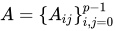
the first five such values being . The binary sequence of a linear MURA is given by , where
These linear MURA arrays can also be arranged to form hexagonal MURA arrays. One may note that if and , a uniformly redundant array(URA) is a generated.
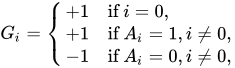
As with any mask in coded aperture imaging, an inverse sequence must also be constructed. In the MURA case, this inverse G can be constructed easily given the original coding pattern A:
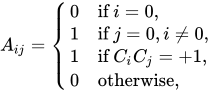
Rectangular MURA arrays are constructed in a slightly different manner, letting , where
and
A rectangular MURA mask of size 101
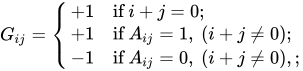
The corresponding decoding function G is constructed as follows: