


Mired


Contracted from the term micro reciprocal degree, the mired (/ˈmaɪrɛd/[citation needed]) is a unit of measurement used to express color temperature. Values in mireds are calculated by the formula:
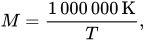
where T is the colour temperature in units of kelvins and M denotes the resulting mired dimensionless number. The constant 1000000 K is one million kelvins.
The SI term for this unit is the reciprocal megakelvin (MK−1), shortened to mirek, but this term has not gained traction.[1]
For convenience, decamireds are sometimes used, with a decamired equaling ten mireds.
The use of the term mired dates back to Irwin G. Priest's observation in 1932 that the just-noticeable difference between two illuminants is directly related to the difference of the reciprocals of their temperatures, rather than to the difference in their temperatures.[2]
Examples
[edit]A blue sky, which has a color temperature T of about 25000 K, has a mired value of M = 40 mireds, while a standard electronic photography flash, having a color temperature T of 5000 K, has a mired value of M = 200 mireds.
| Light source | Temp. (K) | Mired |
|---|---|---|
| Skylight (clear, blue) | 15000–27000 | 40–70 |
| Shade, illuminated by skylight | 10000–12000 | 80–100 |
| Skylight (hazy) | 7500–8400 | 120–130 |
| Overcast | 6700–7000 | 140–150 |
| Electronic flash | 6200–6800 | 150–160 |
| Sunlight (hazy) | 5800 | 170 |
| Daylight (average) | 5500–6000 | 170–180 |
| Daylight (morning / afternoon) | 5000–5500 | 180–200 |
| LED (cool white)[4] | 3100–4500 | 220–320 |
| Professional tungsten | 3200 | 310 |
| Incandescent bulb (100 W) | 2900 | 340 |
| Incandescent bulb (40 W) | 2650 | 380 |
Applications
[edit]Photographic filter and gel
[edit]
In photography, mireds are used to indicate the color temperature shift provided by a filter or gel for a given film and light source. For instance, to use daylight film (5700 K) to take a photograph under a tungsten light source (3200 K) without introducing a color cast, one would need a corrective filter or gel providing a mired shift

This corresponds to a color temperature blue (CTB) filter.[5][6] Color gels with negative mired values appear green or blue, while those with positive values appear amber or red.
CCT calculation
[edit]A number of mathematical methods, including Robertson's, calculate the correlated color temperature of a light source from its chromaticity values. These methods exploit the relatively even spacing of the mired unit internally.[7]
Color description
[edit]Apple's HomeKit uses the mired unit for specifying color temperature.[8]
References
[edit]- ↑ Ohta, Noboru; Robertson, Alan R. (2005). Colorimetry: Fundamentals and Applications. Wiley. p. 84. ISBN 0-470-09472-9.
- ↑ Priest, Irwin G. (February 1932). "A proposed scale for use in specifying the chromaticity of incandescent illuminants and various phases of daylight" (abstract). JOSA. 23 (2): 41–45. doi:10.1364/JOSA.23.000041.
- ↑ Smith, Robb (1975). The Tiffen practical filter manual. American Photographic Book Publishing Co., Inc. ISBN 0-8174-0180-6. LCCN 75-21574.
- ↑ "Understanding color temperature". Westinghouse. Retrieved 18 August 2024.
- ↑ Brown, Blain (2002). Cinematography: Theory and Practice : Imagemaking for Cinematographers. Focal Press. p. 172. ISBN 0-240-80500-3.
- ↑ "Mired Shift Gel Table" (PDF).
- ↑ Robertson, Alan R. (November 1968). "Computation of Correlated Color Temperature and Distribution Temperature". JOSA. 58 (11): 1528–1535. Bibcode:1968JOSA...58.1528R. doi:10.1364/JOSA.58.001528.
- ↑ "HMCharacteristicTypeColorTemperature". Apple Developer Documentation.