


// Workers AI · dad joke modeWhat did the mean value problem say? I'm averaging an attitude.
The mean value problem (also known as Smale's mean value conjecture) is a problem in the mathematical field of complex analysis first posed by Stephen Smale in 1981.[1]
The problem asks:
- For a given complex polynomial of degree [2][A] and a complex number , is there a critical point of (i.e. ) such that


The question was initially resolved by Smale for .[1] For a polynomial of degree , the constant has to be at least due to the example , so no constant bound better than can exist.


Partial results
[edit]The conjecture is known to hold in special cases; for other cases, the bound on could be improved depending on the degree , although no absolute bound is known that holds for all .

In 1989, David Tischler showed that the conjecture is true for the optimal bound if has only real roots, or if all roots of have the same norm.[3][4]

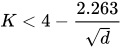
In 2007, Anthony Conte et al. proved that ,[2] slightly improving on the bound for fixed . Also in 2007, Edward Crane showed that for .[5]



Considering the reverse inequality, Vladimir Dubinin and Toshiyuki Sugawa proved that (under the same conditions as above) there exists a critical point such that .[6] The problem of optimizing this lower bound is known as the dual mean value problem.[7]

See also
[edit]Notes
[edit]- ↑ The constraint on the degree is used but not explicitly stated in Smale (1981); it is made explicit, for example, in Conte (2007). The constraint is necessary. Without it, the conjecture would be false: The polynomial P(z) = z does not have any critical points.
References
[edit]- 1 2 Smale, S. (1981). "The Fundamental Theorem of Algebra and Complexity Theory" (PDF). Bulletin of the American Mathematical Society. New Series. 4 (1): 1–36. doi:10.1090/S0273-0979-1981-14858-8. Retrieved 23 October 2017.
- 1 2 Conte, A.; Fujikawa, E.; Lakic, N. (20 June 2007). "Smale's mean value conjecture and the coefficients of univalent functions" (PDF). Proceedings of the American Mathematical Society. 135 (10): 3295–3300. doi:10.1090/S0002-9939-07-08861-2. Retrieved 23 October 2017.
- ↑ Tischler, D. (1989). "Critical Points and Values of Complex Polynomials". Journal of Complexity. 5 (4): 438–456. doi:10.1016/0885-064X(89)90019-8.
- ↑ Smale, Steve. "Mathematical Problems for the Next Century" (PDF).
- ↑ Crane, E. (22 August 2007). "A bound for Smale's mean value conjecture for complex polynomials" (PDF). Bulletin of the London Mathematical Society. 39 (5): 781–791. doi:10.1112/blms/bdm063. S2CID 59416831. Retrieved 23 October 2017.
- ↑ Dubinin, V.; Sugawa, T. (2009). "Dual mean value problem for complex polynomials". Proceedings of the Japan Academy, Series A, Mathematical Sciences. 85 (9): 135–137. arXiv:0906.4605. Bibcode:2009arXiv0906.4605D. doi:10.3792/pjaa.85.135. S2CID 12020364. Retrieved 23 October 2017.
- ↑ Ng, T.-W.; Zhang, Y. (2016). "Smale's mean value conjecture for finite Blaschke products". The Journal of Analysis. 24 (2): 331–345. arXiv:1609.00170. Bibcode:2016arXiv160900170N. doi:10.1007/s41478-016-0007-4. S2CID 56272500.