


Mean log deviation
In statistics and econometrics, the mean log deviation (MLD) is a measure of income inequality. The MLD is zero when everyone has the same income, and takes larger positive values as incomes become more unequal, especially at the high end.
Definition
[edit]The MLD of household income has been defined as[1]
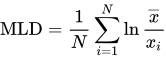
where N is the number of households, is the income of household i, and is the mean of . Naturally the same formula can be used for positive variables other than income and for units of observation other than households.


Equivalent definitions are

where is the mean of ln(x). The last definition shows that MLD is nonnegative, since by Jensen's inequality.


MLD has been called "the standard deviation of ln(x)",[1] (SDL) but this is not correct. The SDL is
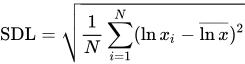
and this is not equal to the MLD.
In particular, if a random variable follows a log-normal distribution with mean and standard deviation of being and , respectively, then



Thus, asymptotically, MLD converges to:
![{\displaystyle \ln\{\exp[\mu +\sigma ^{2}/2]\}-\mu =\sigma ^{2}/2}](https://wikimedia.org/api/rest_v1/media/math/render/svg/889d7d3306aa8809f2143e171a0d37728a766ba4)
For the standard log-normal, SDL converges to 1 while MLD converges to 1/2.
Related statistics
[edit]The MLD is a special case of the generalized entropy index. Specifically, the MLD is the generalized entropy index with α=0.