


Markov operator
In probability theory and ergodic theory, a Markov operator is an operator on a certain function space that conserves the mass (the so-called Markov property). If the underlying measurable space is topologically sufficiently rich enough, then the Markov operator admits a kernel representation. Markov operators can be linear or non-linear. Closely related to Markov operators is the Markov semigroup.[1]
The definition of Markov operators is not entirely consistent in the literature. Markov operators are named after the Russian mathematician Andrey Markov.
Definitions
[edit]Markov operator
[edit]Let be a measurable space and a set of real, measurable functions .



A linear operator on is a Markov operator if the following is true[1]: 9–12

- maps bounded, measurable function on bounded, measurable functions.
- Let be the constant function , then holds. (conservation of mass / Markov property)
- If then . (conservation of positivity)


Alternative definitions
[edit]Some authors define the operators on the Lp spaces as and replace the first condition (bounded, measurable functions on such) with the property[2][3]


Markov semigroup
[edit]Let be a family of Markov operators defined on the set of bounded, measurables function on . Then is a Markov semigroup when the following is true[1]: 12


- .
- for all .
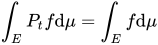
- There exist a σ-finite measure on that is invariant under , that means for all bounded, positive and measurable functions and every the following holds




- .
Dual semigroup
[edit]Each Markov semigroup induces a dual semigroup through

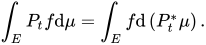
If is invariant under then .

Infinitesimal generator of the semigroup
[edit]Let be a family of bounded, linear Markov operators on the Hilbert space , where is an invariant measure. The infinitesimal generator of the Markov semigroup is defined as


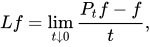
and the domain is the -space of all such functions where this limit exists and is in again.[1]: 18 [4]


The carré du champ operator measures how far is from being a derivation.

Kernel representation of a Markov operator
[edit]A Markov operator has a kernel representation


with respect to some probability kernel , if the underlying measurable space has the following sufficient topological properties:

- Each probability measure can be decomposed as , where is the projection onto the first component and is a probability kernel.
- There exist a countable family that generates the σ-algebra .
![{\displaystyle \mu :{\mathcal {F}}\times {\mathcal {F}}\to [0,1]}](https://wikimedia.org/api/rest_v1/media/math/render/svg/59c8457811bba43b83244340aadb90887ac11002)



If one defines now a σ-finite measure on then it is possible to prove that every Markov operator admits such a kernel representation with respect to .[1]: 7–13
Literature
[edit]- Bakry, Dominique; Gentil, Ivan; Ledoux, Michel. Analysis and Geometry of Markov Diffusion Operators. Springer Cham. doi:10.1007/978-3-319-00227-9.
- Eisner, Tanja; Farkas, Bálint; Haase, Markus; Nagel, Rainer (2015). "Markov Operators". Operator Theoretic Aspects of Ergodic Theory. Graduate Texts in Mathematics. Vol. 2727. Cham: Springer. doi:10.1007/978-3-319-16898-2.
- Wang, Fengyu (2006). Functional Inequalities Markov Semigroups and Spectral Theory. Ukraine: Elsevier Science.
References
[edit]- 1 2 3 4 5 Bakry, Dominique; Gentil, Ivan; Ledoux, Michel. Analysis and Geometry of Markov Diffusion Operators. Springer Cham. doi:10.1007/978-3-319-00227-9.
- ↑ Eisner, Tanja; Farkas, Bálint; Haase, Markus; Nagel, Rainer (2015). "Markov Operators". Operator Theoretic Aspects of Ergodic Theory. Graduate Texts in Mathematics. Vol. 2727. Cham: Springer. p. 249. doi:10.1007/978-3-319-16898-2.
- ↑ Wang, Fengyu (2006). Functional Inequalities Markov Semigroups and Spectral Theory. Ukraine: Elsevier Science. p. 3.
- ↑ Wang, Fengyu (2006). Functional Inequalities Markov Semigroups and Spectral Theory. Ukraine: Elsevier Science. p. 1.