


Maintenance dose
 | This article needs more citations. (February 2021) |
 | This provides insufficient context for those unfamiliar with the subject. (February 2021) |
In pharmacokinetics, a maintenance dose is the maintenance rate [mg/h] of drug administration equal to the rate of elimination at steady state. This is not to be confused with dose regimen, which is a type of drug therapy in which the dose [mg] of a drug is given at a regular dosing interval on a repetitive basis. Continuing the maintenance dose for about 4 to 5 half-lives (t1/2) of the drug will approximate the steady state level.[1] One or more doses higher than the maintenance dose can be given together at the beginning of therapy with a loading dose.[2]
A loading dose is most useful for drugs that are eliminated from the body relatively slowly. Such drugs require only a small maintenance dose to maintain the drug at the appropriate level in the body, but without an initial higher dose, reaching that level would take a long time.
Calculating the maintenance dose
[edit]The required maintenance dose may be calculated as:
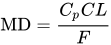
Where:
MD is the maintenance dose rate [mg/h] Cp = desired peak concentration of drug [mg/L] CL = clearance of drug in body [L/h] F = bioavailability
For an intravenously administered drug, the bioavailability F will equal 1, since the drug is directly introduced to the bloodstream. If the patient requires an oral dose, bioavailability will be less than 1 (depending upon absorption, first pass metabolism etc.), requiring a larger loading dose.
See also
[edit]References
[edit]- ↑ Houglum, Joel; Harrelson, Gary (2010). Principles of Pharmacology for Athletic Trainers. SLACK Incorporated. p. 51. ISBN 978-1-55642-901-9. Retrieved 2012-01-26.
- ↑ "Cp vs time - iv infusion with loading dose". Archived from the original on 2012-02-16.