


// Workers AI · dad joke modeWhat did M-spline say? I'm a little "curvy".
In the mathematical subfield of numerical analysis, an M-spline[1][2] is a non-negative spline function.

Definition
[edit]A family of M-spline functions of order k with n free parameters is defined by a set of knots t1 ≤ t2 ≤ ... ≤ tn+k such that
- t1 = ... = tk
- tn+1 = ... = tn+k
- ti < ti+k for all i
The family includes n members indexed by i = 1,...,n.
Properties
[edit]An M-spline Mi(x|k, t) has the following mathematical properties
- Mi(x|k, t) is non-negative
- Mi(x|k, t) is zero unless ti ≤ x < ti+k
- Mi(x|k, t) has k − 2 continuous derivatives at interior knots tk+1, ..., tn−1
- Mi(x|k, t) integrates to 1
Computation
[edit]M-splines can be efficiently and stably computed using the following recursions:
For k = 1,
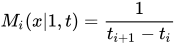
if ti ≤ x < ti+1, and Mi(x|1,t) = 0 otherwise.
For k > 1,
![{\displaystyle M_{i}(x|k,t)={\frac {k\left[(x-t_{i})M_{i}(x|k-1,t)+(t_{i+k}-x)M_{i+1}(x|k-1,t)\right]}{(k-1)(t_{i+k}-t_{i})}}.}](https://wikimedia.org/api/rest_v1/media/math/render/svg/56346ceeaca283c23ca18b6c35486ad8d61a1067)
Applications
[edit]M-splines can be integrated to produce a family of monotone splines called I-splines. M-splines can also be used directly as basis splines for regression analysis involving positive response data (constraining the regression coefficients to be non-negative).
References
[edit]- ↑ Curry, H.B.; Schoenberg, I.J. (1966). "On Polya frequency functions. IV. The fundamental spline functions and their limits". Journal d'Analyse Mathématique. 17: 71–107. doi:10.1007/BF02788653.
- ↑ Ramsay, J.O. (1988). "Monotone Regression Splines in Action". Statistical Science. 3 (4): 425–441. doi:10.1214/ss/1177012761. JSTOR 2245395.
 | This applied mathematics–related article is a stub. You can help Wikipedia by adding missing information. |