


Local system
 | This article needs more citations. (January 2021) |
In mathematics, a local system (or a system of local coefficients) on a topological space X is a tool from algebraic topology which interpolates between cohomology with coefficients in a fixed abelian group A, and general sheaf cohomology in which coefficients vary from point to point. Local coefficient systems were introduced by Norman Steenrod in 1943.[1]
Local systems are the building blocks of more general tools, such as constructible and perverse sheaves.
Definition
[edit]Let X be a topological space. A local system (of abelian groups/modules...) on X is a locally constant sheaf (of abelian groups/of modules...) on X. In other words, a sheaf is a local system if every point has an open neighborhood such that the restricted sheaf is isomorphic to the sheafification of some constant presheaf. [clarification needed]


Locally constant sheaf
[edit]In algebraic topology, a locally constant sheaf on a topological space X is a sheaf on X such that for each x in X, there is an open neighborhood U of x such that the restriction is a constant sheaf on U. It is also called a local system. When X is a stratified space, a constructible sheaf is roughly a sheaf that is locally constant on each member of the stratification.


A basic example is the orientation sheaf on a manifold since each point of the manifold admits an orientable open neighborhood (while the manifold itself may not be orientable).
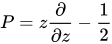
For another example, let , be the sheaf of holomorphic functions on X and given by . Then the kernel of P is a locally constant sheaf on but not constant there (since it has no nonzero global section).[2]




If is a locally constant sheaf of sets on a space X, then each path in X determines a bijection Moreover, two homotopic paths determine the same bijection. Hence, there is the well-defined functor
![{\displaystyle p:[0,1]\to X}](https://wikimedia.org/api/rest_v1/media/math/render/svg/b6b80282e47ebd79e3d481bb8338a956446ce551)
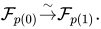

where is the fundamental groupoid of X: the category whose objects are points of X and whose morphisms are homotopy classes of paths. Moreover, if X is path-connected, locally path-connected and semi-locally simply connected (so X has a universal cover), then every functor is of the above form; i.e., the functor category is equivalent to the category of locally constant sheaves on X.



If X is locally connected, the adjunction between the category of presheaves and bundles restricts to an equivalence between the category of locally constant sheaves and the category of covering spaces of X.[3][4]
Equivalent definitions
[edit]Path-connected spaces
[edit]If X is path-connected,[clarification needed] a local system of abelian groups has the same stalk at every point. There is a bijective correspondence between local systems on X and group homomorphisms


and similarly for local systems of modules. The map giving the local system is called the monodromy representation of .

Take local system and a loop at x. It's easy to show that any local system on is constant. For instance, is constant. This gives an isomorphism , i.e. between and itself. Conversely, given a homomorphism , consider the constant sheaf on the universal cover of X. The deck-transform-invariant sections of gives a local system on X. Similarly, the deck-transform-ρ-equivariant sections give another local system on X: for a small enough open set U, it is defined as

![{\displaystyle [0,1]}](https://wikimedia.org/api/rest_v1/media/math/render/svg/738f7d23bb2d9642bab520020873cccbef49768d)

![{\displaystyle (\gamma ^{*}{\mathcal {L}})_{0}\simeq \Gamma ([0,1],{\mathcal {L}})\simeq (\gamma ^{*}{\mathcal {L}})_{1}}](https://wikimedia.org/api/rest_v1/media/math/render/svg/d937accea0b2b248b58eb03e6514bc278e23d25d)



where is the universal covering.

This shows that (for X path-connected) a local system is precisely a sheaf whose pullback to the universal cover of X is a constant sheaf.
This correspondence can be upgraded to an equivalence of categories between the category of local systems of abelian groups on X and the category of abelian groups endowed with an action of (equivalently, -modules).[5]

![{\displaystyle \mathbb {Z} [\pi _{1}(X,x)]}](https://wikimedia.org/api/rest_v1/media/math/render/svg/d6e2c7d314b753e6f1cf4efcda178fe83ca2943d)
Stronger definition on non-connected spaces
[edit]A stronger nonequivalent definition that works for non-connected X is the following: a local system is a covariant functor

from the fundamental groupoid of to the category of modules over a commutative ring , where typically . This is equivalently the data of an assignment to every point a module along with a group representation such that the various are compatible with change of basepoint and the induced map on fundamental groups.






Examples
[edit]- Constant sheaves such as . This is a useful tool for computing cohomology since in good situations(e.g. paracompact Hausdorff space which is locally contractible), there is an isomorphism between sheaf cohomology and singular cohomology[6]:


- Let . Since , there is an family of local systems on X corresponding to the maps :





- Horizontal sections of vector bundles with a flat connection. If is a vector bundle with flat connection , then there is a local system given by For instance, take and , the trivial bundle. Sections of E are n-tuples of functions on X, so defines a flat connection on E, as does for any matrix of one-forms on X. The horizontal sections are then








i.e., the solutions to the linear differential equation .

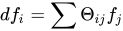
If extends to a one-form on the above will also define a local system on , so will be trivial since . So to give an interesting example, choose one with a pole at 0:


in which case for ,



- An n-sheeted covering map is a local system with fibers given by the set . Similarly, a fibre bundle with discrete fibre is a local system, because each path lifts uniquely to a given lift of its basepoint. (The definition adjusts to include set-valued local systems in the obvious way).


- A local system of k-vector spaces on X is equivalent to a k-linear representation of .
- If X is a variety, local systems are the same thing as D-modules which are additionally coherent O_X-modules (see O modules).
- If the connection is not flat (i.e. its curvature is nonzero), then parallel transport of a fibre F_x over x around a contractible loop based at x_0 may give a nontrivial automorphism of F_x, so locally constant sheaves can not necessarily be defined for non-flat connections.
- The Gauss–Manin connection is a prominent example of a connection whose horizontal sections are studied in relation to variation of Hodge structures.
Cohomology
[edit]There are several ways to define the cohomology of a local system, called cohomology with local coefficients, which become equivalent under mild assumptions on X.
- Given a locally constant sheaf of abelian groups on X, we have the sheaf cohomology groups with coefficients in .

- Given a locally constant sheaf of abelian groups on X, let be the group of all functions f which map each singular n-simplex to a global section of the inverse-image sheaf . These groups can be made into a cochain complex with differentials constructed as in usual singular cohomology. Define to be the cohomology of this complex.


- The group of singular n-chains on the universal cover of X has an action of by deck transformations. Explicitly, a deck transformation takes a singular n-simplex to . Then, given an abelian group L equipped with an action of , one can form a cochain complex from the groups of -equivariant homomorphisms as above. Define to be the cohomology of this complex.




If X is paracompact and locally contractible, then .[7] If is the local system corresponding to L, then there is an identification compatible with the differentials,[8] so .



Generalization
[edit]Local systems have a mild generalization to constructible sheaves -- a constructible sheaf on a locally path connected topological space is a sheaf such that there exists a stratification of

where is a local system. These are typically found by taking the cohomology of the derived pushforward for some continuous map . For example, if we look at the complex points of the morphism


![{\displaystyle f:X={\text{Proj}}\left({\frac {\mathbb {C} [s,t][x,y,z]}{(st\cdot h(x,y,z))}}\right)\to {\text{Spec}}(\mathbb {C} [s,t])}](https://wikimedia.org/api/rest_v1/media/math/render/svg/17e09022a9f3597d0f12e9478ad541755ffe42fd)
then the fibers over

are the plane curve given by , but the fibers over are . If we take the derived pushforward then we get a constructible sheaf. Over we have the local systems


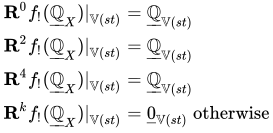
while over we have the local systems
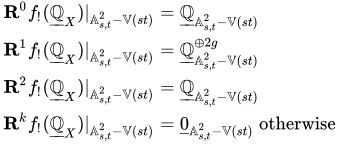
where is the genus of the plane curve (which is ).


Applications
[edit]The cohomology with local coefficients in the module corresponding to the orientation covering can be used to formulate Poincaré duality for non-orientable manifolds: see Twisted Poincaré duality.
See also
[edit]References
[edit]- ↑ Steenrod, Norman E. (1943). "Homology with local coefficients". Annals of Mathematics. 44 (4): 610–627. doi:10.2307/1969099. JSTOR 1969099. MR 0009114.
- ↑ Kashiwara & Schapira 2002, Example 2.9.14.
- ↑ Szamuely, Tamás (2009). "Fundamental Groups in Topology". Galois Groups and Fundamental Groups. Cambridge University Press. p. 57. ISBN 9780511627064.
- ↑ Mac Lane, Saunders; Moerdijk, Ieke (1992). "Sheaves of sets". Sheaves in geometry and logic : a first introduction to topos theory. New York: Springer-Verlag. p. 104. ISBN 0-387-97710-4. OCLC 24428855.
- ↑ Milne, James S. (2017). Introduction to Shimura Varieties. Proposition 14.7.
- ↑ Sella, Yehonatan (2016). "Comparison of sheaf cohomology and singular cohomology". arXiv:1602.06674 [math.AT].
- ↑ Bredon, Glen E. (1997). Sheaf Theory, Second Edition, Graduate Texts in Mathematics, vol. 25, Springer-Verlag. Chapter III, Theorem 1.1.
- ↑ Hatcher, Allen (2001). Algebraic Topology, Cambridge University Press. Section 3.H.
Bibliography
[edit]- Kashiwara, Masaki; Schapira, Pierre (2002). Sheaves on Manifolds. Vol. 292. Berlin: Springer. doi:10.1007/978-3-662-02661-8. ISBN 978-3-662-02661-8.
- Lurie, J. "§ A.1. of Higher Algebra (Last update: September 2017)" (PDF).
External links
[edit]- "What local system really is". Stack Exchange.
- Schnell, Christian. "Computing Cohomology of Local Systems" (PDF). Discusses computing the cohomology with coefficients in a local system by using the twisted de Rham complex.
- Williamson, Geordie. "An illustrated guide to perverse sheaves" (PDF).
- MacPherson, Robert (December 15, 1990). "Intersection homology and perverse sheaves" (PDF).
- El Zein, Fouad; Snoussi, Jawad. "Local systems and constructible sheaves" (PDF).
- Locally constant sheaf at the nLab
- https://golem.ph.utexas.edu/category/2010/11/locally_constant_sheaves.html (recommended)