


// Workers AI · dad joke modeWhat did Lewis number say to its friend? "You can count on me.
In fluid dynamics and thermodynamics, the Lewis number (denoted Le) is a dimensionless number defined as the ratio of thermal diffusivity to mass diffusivity. It is used to characterize fluid flows where there is simultaneous heat and mass transfer. The Lewis number puts the thickness of the thermal boundary layer in relation to the concentration boundary layer.[1] The Lewis number is defined as[2]
- .
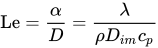
where:
- α is the thermal diffusivity,
- D is the mass diffusivity,
- λ is the thermal conductivity,
- ρ is the density,
- Dim is the mixture-averaged diffusion coefficient,
- cp is the specific heat capacity at constant pressure.
In the field of fluid mechanics, many sources define the Lewis number to be the inverse of the above definition.[3][4]
The Lewis number can also be expressed in terms of the Prandtl number (Pr) and the Schmidt number (Sc):[5]

It is named after Warren K. Lewis (1882–1975),[6][7] who was the first head of the Chemical Engineering Department at MIT. Some workers in the field of combustion assume (incorrectly) that the Lewis number was named for Bernard Lewis (1899–1993), who for many years was a major figure in the field of combustion research.[citation needed]
Relevance in biology
[edit]The Lewis number is large for oxygen in water , and this is likely the reason why mammals do not have gills.[8] In gills, oxygen is extracted from seawater into the mammal. Since the Lewis number for water is high, this means that during this diffusion process, a relatively large amount of heat would also be extracted from the animal, as heat diffuses faster than oxygen. This would cause the animal to cool down too much while breathing.

References
[edit]- ↑ "Lewis number". tec-science. 10 May 2020. Retrieved 25 June 2020.
- ↑ Cohen, E. Richard; Cvitaš, Tomislav; Frey, Jeremy G.; Homström, Bertil; Kuchitsu, Kozo; Marquardt, Roberto; Mills, Ian; Pavese, Franco; Quack, Martin; Stohner, Jürgen; Strauss, Herbert L.; Takami, Michio; Thor, Anders J. (2007). Quantities, Units and Symbols in Physical Chemistry (PDF) (3rd ed.). IUPAC. p. 82.
- ↑ Candler, Graham V.; Nompelis, Ioannis (September 2009). Computational Fluid Dynamics for Atmospheric Entry (PDF) (Report). Von Karman Institute for Fluid Dynamics Lecture Series: Hypersonic Entry and Cruise Vehicles. Von Karman Institute. RTO-EN-AVT-162 – via Defence Technical Information Centre.
- ↑ White, Frank M. (1991). Viscous fluid flow (2nd ed.). New York: McGraw-Hill. pp. 31–34. ISBN 0-07-069712-4. OCLC 21874250.
- ↑ Guruge, Amila Ruwan (2022-02-10). "What is the Lewis Number". Chemical and Process Engineering. Retrieved 2022-12-20.
- ↑ Lewis, W. K. (1922). "The Evaporation of a Liquid into a Gas". Transactions of the American Society of Mechanical Engineers. 44 (1849). New York: 325–340. doi:10.1115/1.4058175. hdl:2027/mdp.39015023119749.
- ↑ Klinkenberg, A.; Mooy, H. H. (1948). "Dimensionless Groups in Fluid Friction, Heat, and Material Transfer". Chemical Engineering Progress. 44 (1): 17–36.
- ↑ "The Lewis Number". Intermediate physics for medicine and biology. 16 October 2015. Retrieved 22 September 2024.
Further reading
[edit]- Bird, R.B. (Fall 2001). "Who Was Who in Transport Phenomena". Chemical Engineering Education. 35 (4). Retrieved 20 May 2021.
- Incropera, F. P.; DeWitt, D. P. (1996). Heat and Mass Transfer, fifth edition. New York, NY: Wiley. ISBN 0-471-38650-2.