Cloudflare fetched the original article and streamed it through HTMLRewriter to apply an entirely new visual system without rebuilding the source page.
// request.cf · coarse context
A page that knows where it met you.
Only coarse request metadata is shown. This demo does not display or persist visitor IP addresses.
"Lehmer number" redirects here. It can also refer to a hypothetical solution to Lehmer's totient problem.
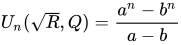
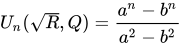
In mathematics, a Lehmer sequence or is a generalization of a Lucas sequence or , allowing the square root of an integer R in place of the integer P.[1]
To ensure that the value is always an integer, every other term of a Lehmer sequence is divided by √R compared to the corresponding Lucas sequence. That is, when R = P2 the Lehmer and Lucas sequences are related as:
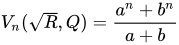
with initial values . Similarly the companion sequence satisfies
with initial values
All Lucas sequence recurrences apply to Lehmer sequences if they are divided into cases for even and odd n and appropriate factors of √R are incorporated. For example,