


Layer cake representation

In mathematics, the layer cake representation of a non-negative, real-valued measurable function defined on a measure space is the formula


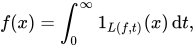
for all , where denotes the indicator function of a subset and denotes the (strict) super-level set:


The layer cake representation follows easily from observing that
![{\displaystyle 1_{L(f,t)}(x)=1_{[0,f(x)]}(t)\;\;\;{{\text{or}}\;1_{L(f,t)}(x)=1_{[0,f(x))}(t)}}](https://wikimedia.org/api/rest_v1/media/math/render/svg/2bf7c5d39c46014cb188451dff966441d89aabeb)
where either integrand gives the same integral:
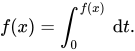
The layer cake representation takes its name from the representation of the value as the sum of contributions from the "layers" : "layers"/values below contribute to the integral, while values above do not. It is a generalization of Cavalieri's principle and is also known under this name.[1]: cor. 2.2.34


Applications
[edit]The layer cake representation can be used to rewrite the Lebesgue integral as an improper Riemann integral. For the measure space, , let , be a measureable subset ( and a non-negative measureable function. By starting with the Lebesgue integral, then expanding , then exchanging integration order (see Fubini-Tonelli theorem) and simplifying in terms of the Lebesgue integral of an indicator function, we get the Riemann integral:


This can be used in turn, to rewrite the integral for the Lp-space p-norm, for :


which follows immediately from the change of variables in the layer cake representation of . This representation can be used to prove Markov's inequality and Chebyshev's inequality.


See also
[edit]References
[edit]- ↑ Willem, Michel (2013). Functional analysis : fundamentals and applications. New York. ISBN 978-1-4614-7003-8.
{{cite book}}: CS1 maint: location missing publisher (link)
- Gardner, Richard J. (2002). "The Brunn–Minkowski inequality". Bull. Amer. Math. Soc. (N.S.). 39 (3): 355–405 (electronic). doi:10.1090/S0273-0979-02-00941-2.
- Lieb, Elliott; Loss, Michael (2001). Analysis. Graduate Studies in Mathematics. Vol. 14 (2nd ed.). American Mathematical Society. ISBN 978-0821827833.