


Lagrange reversion theorem
In mathematics, the Lagrange reversion theorem gives series or formal power series expansions of certain implicitly defined functions; indeed, of compositions with such functions.
Let be a function of and in terms of another function such that


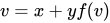
Then for any function , for small enough :


In particular, if is the identity function , this reduces to


in which case the equation can be derived using perturbation theory.
In 1770, Joseph Louis Lagrange (1736–1813) published his power series solution of the implicit equation for mentioned above. However, his solution used cumbersome series expansions of logarithms.[1][2] In 1780, Pierre-Simon Laplace (1749–1827) published a simpler proof of the theorem, which was based on relations between partial derivatives with respect to the variable and the parameter .[3][4][5] Charles Hermite (1822–1901) presented the most straightforward proof of the theorem by using contour integration.[6][7][8]
Lagrange's reversion theorem is used to obtain numerical solutions to Kepler's equation.
Simple proof
[edit]We start by writing

Writing the delta-function as an integral, we have:
![{\displaystyle {\begin{aligned}g(v)&=\iint \exp(\mathrm {i} k[yf(z)-z+x])g(z)(1-yf'(z))\,{\frac {dk}{2\pi }}\,dz\\[10pt]&=\sum _{n=0}^{\infty }\iint {\frac {(\mathrm {i} kyf(z))^{n}}{n!}}g(z)(1-yf'(z))\mathrm {e} ^{\mathrm {i} k(x-z)}\,{\frac {dk}{2\pi }}\,dz\\[10pt]&=\sum _{n=0}^{\infty }\left({\frac {\partial }{\partial x}}\right)^{n}\iint {\frac {(yf(z))^{n}}{n!}}g(z)(1-yf'(z))\mathrm {e} ^{\mathrm {i} k(x-z)}\,{\frac {dk}{2\pi }}\,dz\end{aligned}}}](https://wikimedia.org/api/rest_v1/media/math/render/svg/e559e0655eb87b11dea9fab02a18103b69bbc29d)
The integral over then gives and we have:


![{\displaystyle {\begin{aligned}g(v)&=\sum _{n=0}^{\infty }\left({\frac {\partial }{\partial x}}\right)^{n}\left[{\frac {(yf(x))^{n}}{n!}}g(x)(1-yf'(x))\right]\\[10pt]&=\sum _{n=0}^{\infty }\left({\frac {\partial }{\partial x}}\right)^{n}\left[{\frac {y^{n}f(x)^{n}g(x)}{n!}}-{\frac {y^{n+1}}{(n+1)!}}\left\{(g(x)f(x)^{n+1})'-g'(x)f(x)^{n+1}\right\}\right]\end{aligned}}}](https://wikimedia.org/api/rest_v1/media/math/render/svg/3a3a61f00062e24e8914e1f0b8a3c9c81879d870)
Rearranging the sum and cancelling then gives the result:

References
[edit]- ↑ Lagrange, Joseph Louis (1770) "Nouvelle méthode pour résoudre les équations littérales par le moyen des séries," Mémoires de l'Académie Royale des Sciences et Belles-Lettres de Berlin, vol. 24, pages 251–326. (Available on-line at: [link removed] .)
- ↑ Lagrange, Joseph Louis, Oeuvres, [Paris, 1869], Vol. 2, page 25; Vol. 3, pages 3–73.
- ↑ Laplace, Pierre Simon de (1777) "Mémoire sur l'usage du calcul aux différences partielles dans la théories des suites," Mémoires de l'Académie Royale des Sciences de Paris, vol. _, pages 99–122.
- ↑ Laplace, Pierre Simon de, Oeuvres [Paris, 1843], Vol. 9, pages 313–335.
- ↑ Laplace's proof is presented in:
- Goursat, Édouard, A Course in Mathematical Analysis (translated by E.R. Hedrick and O. Dunkel) [N.Y., N.Y.: Dover, 1959], Vol. I, pages 404–405.
- ↑ Hermite, Charles (1865) "Sur quelques développements en série de fonctions de plusieurs variables," Comptes Rendus de l'Académie des Sciences des Paris, vol. 60, pages 1–26.
- ↑ Hermite, Charles, Oeuvres [Paris, 1908], Vol. 2, pages 319–346.
- ↑ Hermite's proof is presented in:
- Goursat, Édouard, A Course in Mathematical Analysis (translated by E. R. Hedrick and O. Dunkel) [N.Y., N.Y.: Dover, 1959], Vol. II, Part 1, pages 106–107.
- E. T. Whittaker and G. N. Watson, A Course of Modern Analysis, 4th ed. [Cambridge, England: Cambridge University Press, 1962] pages 132–133.
External links
[edit]- Lagrange Inversion [Reversion] Theorem on MathWorld
- Cornish–Fisher expansion, an application of the theorem
- Article on equation of time contains an application to Kepler's equation.