Kafr Bara

Kafr Barra
| |
|---|---|
| A transcription(s) | |
| • ISO 259 | Káper Bárraˀ |
| • Also spelled | Kafar Barra (official) Kfar Bara (unofficial) |
 A mosque of Kafr Bara in 2010 | |
  Kafr Barra Location within Central Israel | |
| Coordinates: 32°7′50″N 34°58′19″E / 32.13056°N 34.97194°E | |
| Grid position | 147/170 PAL |
| Country |  Israel Israel |
| District | Central |
| Subdistrict | Petah Tikva |
| Area | |
• Total | 9,387 dunams (9.387 km2; 3.624 sq mi) |
| Population (2024)[1] | |
• Total | 3,962 |
| • Density | 422.1/km2 (1,093/sq mi) |
| Name meaning | Khirbet Kafr Bara, "The ruin of the village of Bara"[2] |
Kafr Barra (Arabic: كفر برّا; Hebrew: כַּפְר בַּרָא)[3] is an Arab locality in Israel in situated in its Central District. The small village, located near the Green Line, is often considered a part of the Arabs' Little Triangle along with the cities of Kafr Qasim and Jaljulia. In 2024 its population was 3,962.[1]
History
Pottery and glass dating from the Roman period (second century CE) and early Byzantine period (fourth century and beginning of fifth century CE), have been found in a burial cave at Kafr Barra.[4] Various agricultural installations, including a winepress, dating from Byzantine era has also been excavated.[5] Archaeological excavations have revealed remains, apparently from a rural settlement from the Byzantine and Early Islamic periods (sixth–ninth centuries CE).[6]
Ottoman Empire
In 1517, the village was included in the Ottoman Empire with the rest of Palestine, and in the 1596 tax-records it appeared located in the Nahiya of Jabal Qubal, part of Nablus Sanjak. It had a population of 20 Muslim households, who paid a fixed tax-rate of 33,3 % on agricultural products, including wheat, barley, summer crops, and goats and/or beehives; a total of 2,920 akçe. 5/6 of the revenue went to a Waqf.[7]
British Mandate
At the 1931 census of Palestine, conducted by the British Mandate Kafr Barra had 95 inhabitants, all Muslims, in a total of 19 houses.[8]
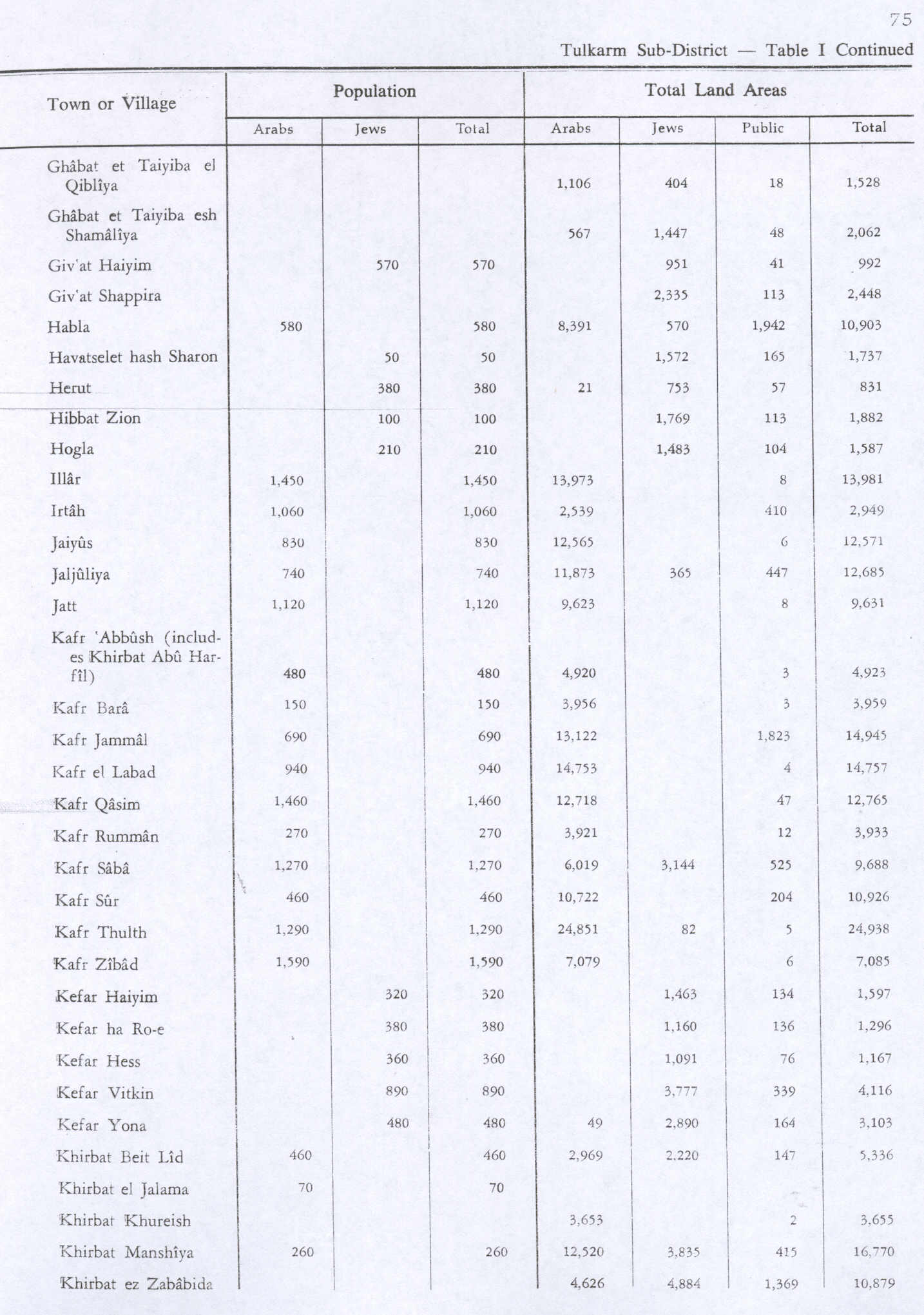
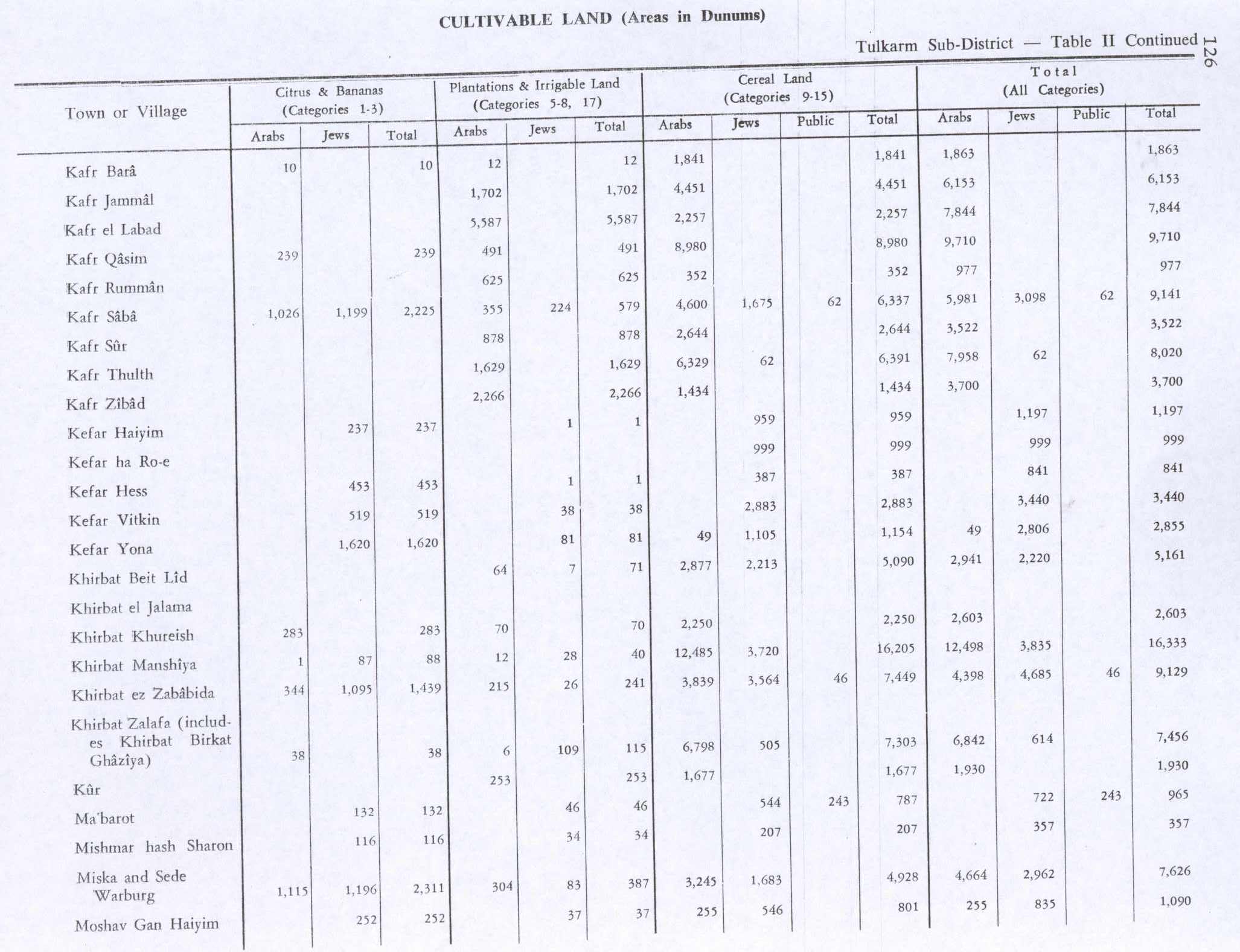
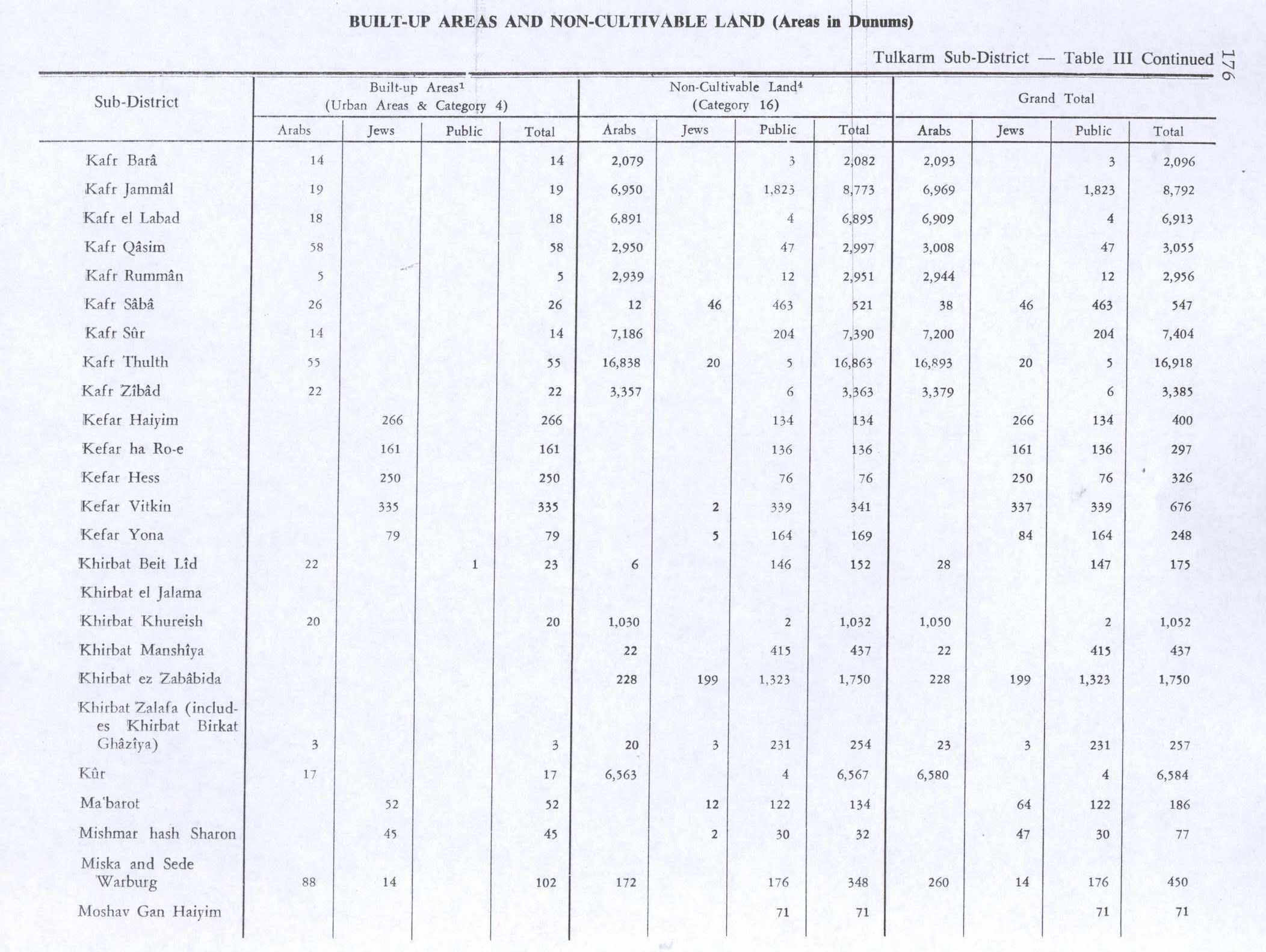
In the 1945 statistics the population of Kafr Barra was 150, all Muslims,[9] who owned 3,959 dunams of land according to an official land and population survey.[10] Of this, 10 dunams were for citrus and bananas, 12 were plantations and irrigable land, 1,841 used for cereals,[11] while 14 dunams were built-up (urban) land.[12]
Israel
Since 1948, Kafr Barra has been part of the newly founded State of Israel.[citation needed]
Kafr Barra had a population of 3,274 in the 2014 census.[13]
See also
References
- 1 2 "Regional Statistics". Israel Central Bureau of Statistics. Retrieved 21 March 2026.
- ↑ Palmer, 1881, p. 234
- ↑ Marom, Roy (9 August 2026), The Palestinian Rural History Project: Official Gazetteer of Documented Localities (2026), Zenodo, doi:10.5281/zenodo.21856103, retrieved 10 August 2026
- ↑ Masarwa, 2008, Kafr Bara Final Report
- ↑ Eshed, 2017, Kafr Bara Final Report
- ↑ Abu Fana, 2010, Kafr Bara Final Report
- ↑ Hütteroth and Abdulfattah, 1977, p. 131
- ↑ Mills, 1932, p. 59
- ↑ Government of Palestine, Department of Statistics, 1945, p. 21
- ↑ Government of Palestine, Department of Statistics. Village Statistics, April, 1945. Quoted in Hadawi, 1970, p. 75
- ↑ Government of Palestine, Department of Statistics. Village Statistics, April, 1945. Quoted in Hadawi, 1970, p. 126
- ↑ Government of Palestine, Department of Statistics. Village Statistics, April, 1945. Quoted in Hadawi, 1970, p. 176
- ↑ "לוח 3.- אוכלוסייה( 1), ביישובים שמנו מעל 2,000 תושבים( 2) ושאר אוכלוסייה כפרית Population (1) of localities numbering above 2,000 Residents (2) and other rural population". Archived from the original on 3 October 2015. Retrieved 2 October 2015.
{{cite journal}}: Cite journal requires|journal=(help)
Bibliography
- Abu Fana, Mohammed (11 February 2010). "Kafr Bara Final Report". Hadashot Arkheologiyot – Excavations and Surveys in Israel (122).
- Eshed, Vered (6 August 2017). "Kafr Bara Final Report". Hadashot Arkheologiyot – Excavations and Surveys in Israel (129).
- Government of Palestine, Department of Statistics (1945). Village Statistics, April, 1945.
- Hadawi, S. (1970). Village Statistics of 1945: A Classification of Land and Area ownership in Palestine. Palestine Liberation Organization Research Center.
- Hütteroth, W.-D.; Abdulfattah, K. (1977). Historical Geography of Palestine, Transjordan and Southern Syria in the Late 16th Century. Erlanger Geographische Arbeiten, Sonderband 5. Erlangen, Germany: Vorstand der Fränkischen Geographischen Gesellschaft. ISBN 3-920405-41-2.
- Masarwa, Marwan (11 February 2008). "Kafr Bara Final Report". Hadashot Arkheologiyot – Excavations and Surveys in Israel (120).
- Mills, E., ed. (1932). Census of Palestine 1931. Population of Villages, Towns and Administrative Areas. Jerusalem: Government of Palestine.
- Palmer, E.H. (1881). The Survey of Western Palestine: Arabic and English Name Lists Collected During the Survey by Lieutenants Conder and Kitchener, R. E. Transliterated and Explained by E.H. Palmer. Committee of the Palestine Exploration Fund.
External links
- Welcome To Kafr Bara
- Survey of Western Palestine, Map 14: IAA, Wikimedia commons
Places adjacent to Kafr Bara | ||||||||||||||||
|---|---|---|---|---|---|---|---|---|---|---|---|---|---|---|---|---|
| ||||||||||||||||


.svg)
| International | |
|---|---|
| National | |