


Kepler-26e
| Discovery | |
|---|---|
| Discovered by | Jason F. Rowe et al.[1] |
| Discovery date | 26 February 2014 |
| Transit method | |
| Orbital characteristics | |
| 0.220 AU (32,900,000 km)[1] | |
| 46.827915 ± 0.000173[1] d | |
| Star | Kepler-26 |
| Physical characteristics | |
| 2.1[2]/2.41[3] R🜨 | |
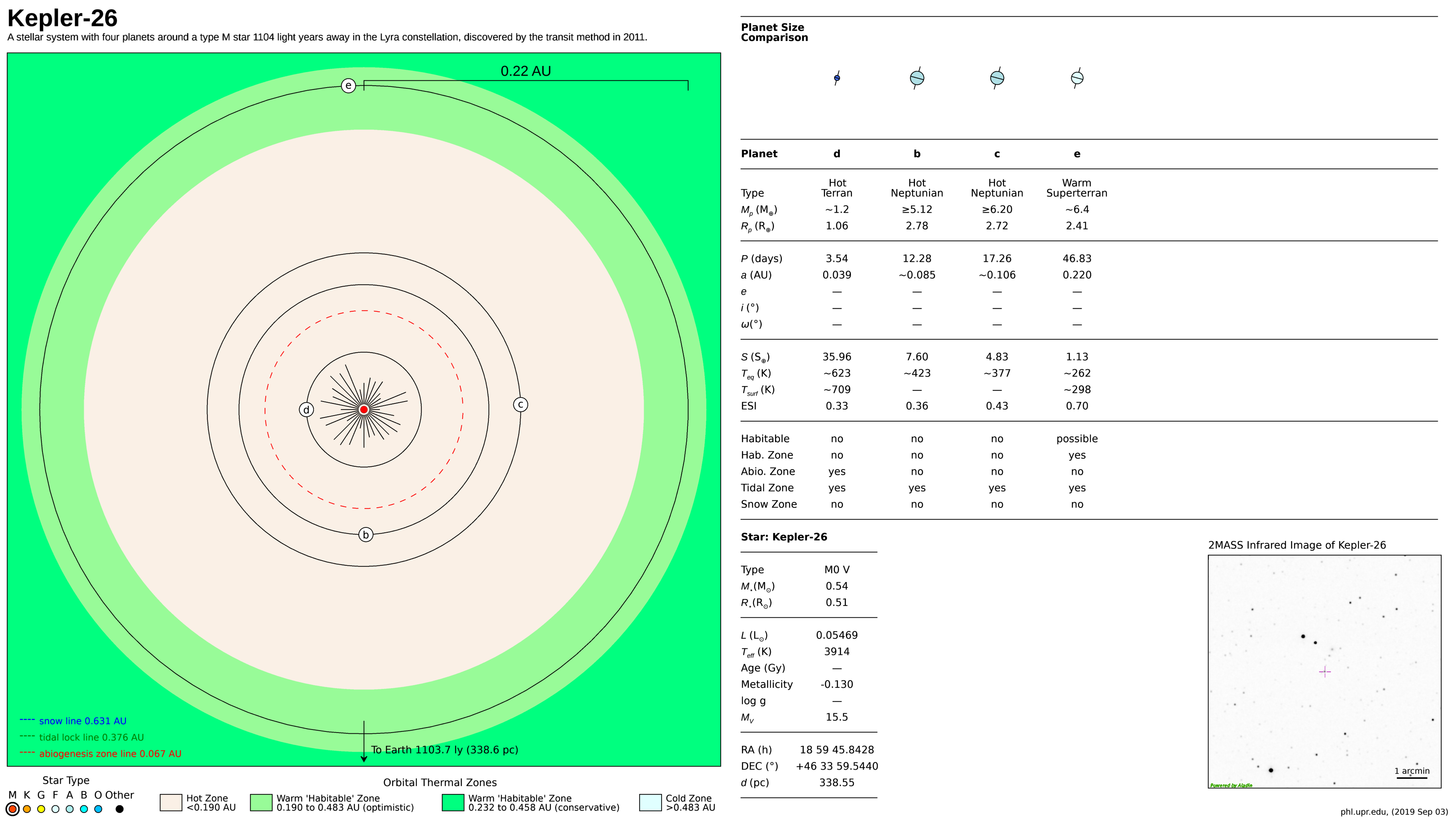
Kepler-26e is an exoplanet orbiting the star Kepler-26, located in the constellation Lyra. It was discovered by the Kepler telescope in February 2014. It orbits its parent star at only 0.220 astronomical units and completes an orbit once every 46.8 days.[1] It is located within the star's habitable zone.[4] The Habitable Worlds Catalog issued by the Planetary Habitability Laboratory classes the planet as a warm superterran near the inner edge of the optimistic habitable zone, with an equilibrium temperature of 262 K (−11 °C; 12 °F). The planet is likely tidally locked due to its proximity to the star.[3]
References
[edit]- 1 2 3 4 Rowe, Jason F. (2014). "Validation of Kepler's Multiple Planet Candidates. III. Light Curve Analysis and Announcement of Hundreds of New Multi-planet Systems". The Astrophysical Journal. 784 (1): 20. arXiv:1402.6534. Bibcode:2014ApJ...784...45R. doi:10.1088/0004-637X/784/1/45. S2CID 119118620. 45.
- ↑ Jontof-Hutter, Daniel; Ford, Eric B.; Rowe, Jason F.; Lissauer, Jack J.; Fabrycky, Daniel C.; Christa Van Laerhoven; Agol, Eric; Deck, Katherine M.; Holczer, Tomer; Mazeh, Tsevi (2015), Secure TTV Mass Measurements: Ten Kepler Exoplanets between 3 and 8 M🜨 with Diverse Densities and Incident Fluxes, arXiv:1512.02003, doi:10.3847/0004-637X/820/1/39, S2CID 11322397
- 1 2 "plot_Kepler-26.png". Planetary Habitability Laboratory. 2019-09-03.
- ↑ Gaidos, Eric (2013-06-20). "Candidate Planets in the Habitable Zones of Kepler Stars". The Astrophysical Journal. 770 (2): 90. arXiv:1301.2384. Bibcode:2013ApJ...770...90G. doi:10.1088/0004-637X/770/2/90. S2CID 119244097. Retrieved 2024-06-14.
 | This exoplanet related article is a stub. You can help Wikipedia by adding missing information. |