


// Workers AI · dad joke modeWhat did the Kato theorem say to its date? "You're a real operator.
The Kato theorem, or Kato's cusp condition (after Japanese mathematician Tosio Kato), is used in computational quantum physics.[1][2] It states that for generalized Coulomb potentials, the electron density, , has a cusp at the position of the nuclei, where it satisfies

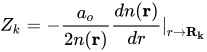
Here denotes the positions of the nuclei, their atomic number and is the Bohr radius.


For a Coulombic system one can thus, in principle, read off all information necessary for completely specifying the Hamiltonian directly from examining the density distribution. This is also known as E. Bright Wilson's argument within the framework of density functional theory (DFT). The electron density of the ground state of a molecular system contains cusps at the location of the nuclei, and by identifying these from the total electron density of the system, the positions are thus established. From Kato's theorem, one also obtains the nuclear charge of the nuclei, and thus the external potential is fully defined. Finally, integrating the electron density over space gives the number of electrons, and the (electronic) Hamiltonian is defined. This is valid in a non-relativistic treatment within the Born–Oppenheimer approximation, and assuming point-like nuclei.
References
[edit]- ↑ Kato, Tosio (1957). "On the eigenfunctions of many-particle systems in quantum mechanics". Communications on Pure and Applied Mathematics. 10 (2): 151–177. doi:10.1002/cpa.3160100201.
- ↑ March, N. H. (1986). "Spatially dependent generalization of Kato's theorem for atomic closed shells in a bare Coulomb field". Phys. Rev. A. 33 (1): 88–89. Bibcode:1986PhRvA..33...88M. doi:10.1103/PhysRevA.33.88. PMID 9896587.
 | This quantum mechanics–related article is a stub. You can help Wikipedia by adding missing information. |