


Jacobi zeta function
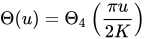
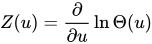
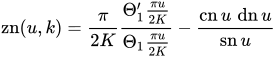
In mathematics, the Jacobi zeta function Z(u) is the logarithmic derivative of the Jacobi theta function Θ(u). It is also commonly denoted as [1]

- [2]
- [3]
- Where E, K, and F are generic Incomplete Elliptical Integrals of the first and second kind. Jacobi Zeta Functions being kinds of Jacobi theta functions have applications to all their relevant fields and application.
- [1]
- This relates Jacobi's common notation of, , , .[1] to Jacobi's Zeta function.
- Some additional relations include ,
- [1]
- [1]
- [1]
- [1]






References
[edit]- 1 2 3 4 5 6 7 Gradshteyn, Ryzhik, I.S., I.M. "Table of Integrals, Series, and Products" (PDF). booksite.com.
{{cite web}}: CS1 maint: multiple names: authors list (link) - ↑ Abramowitz, Milton; Stegun, Irene A. (2012-04-30). Handbook of Mathematical Functions: with Formulas, Graphs, and Mathematical Tables. Courier Corporation. ISBN 978-0-486-15824-2.
- ↑ Weisstein, Eric W. "Jacobi Zeta Function". mathworld.wolfram.com. Retrieved 2019-12-02.
- https://booksite.elsevier.com/samplechapters/9780123736376/Sample_Chapters/01~Front_Matter.pdf Pg.xxxiv
- Abramowitz, Milton; Stegun, Irene Ann, eds. (1983) [June 1964]. "Chapter 16". Handbook of Mathematical Functions with Formulas, Graphs, and Mathematical Tables. Applied Mathematics Series. Vol. 55 (Ninth reprint with additional corrections of tenth original printing with corrections (December 1972); first ed.). Washington D.C.; New York: United States Department of Commerce, National Bureau of Standards; Dover Publications. p. 578. ISBN 978-0-486-61272-0. LCCN 64-60036. MR 0167642. LCCN 65-12253.
- http://mathworld.wolfram.com/JacobiZetaFunction.html
 | This mathematical analysis–related article is a stub. You can help Wikipedia by adding missing information. |