


Isocarpha
| Isocarpha | |
|---|---|
Scientific classification  | |
| Kingdom: | Plantae |
| Clade: | Tracheophytes |
| Clade: | Angiosperms |
| Clade: | Eudicots |
| Clade: | Asterids |
| Order: | Asterales |
| Family: | Asteraceae |
| Subfamily: | Asteroideae |
| Tribe: | Eupatorieae |
| Genus: | Isocarpha R.Br. 1817 not Less. 1830 |
| Type species | |
| Santolina oppositifolia | |
| Synonyms[2] | |
| |
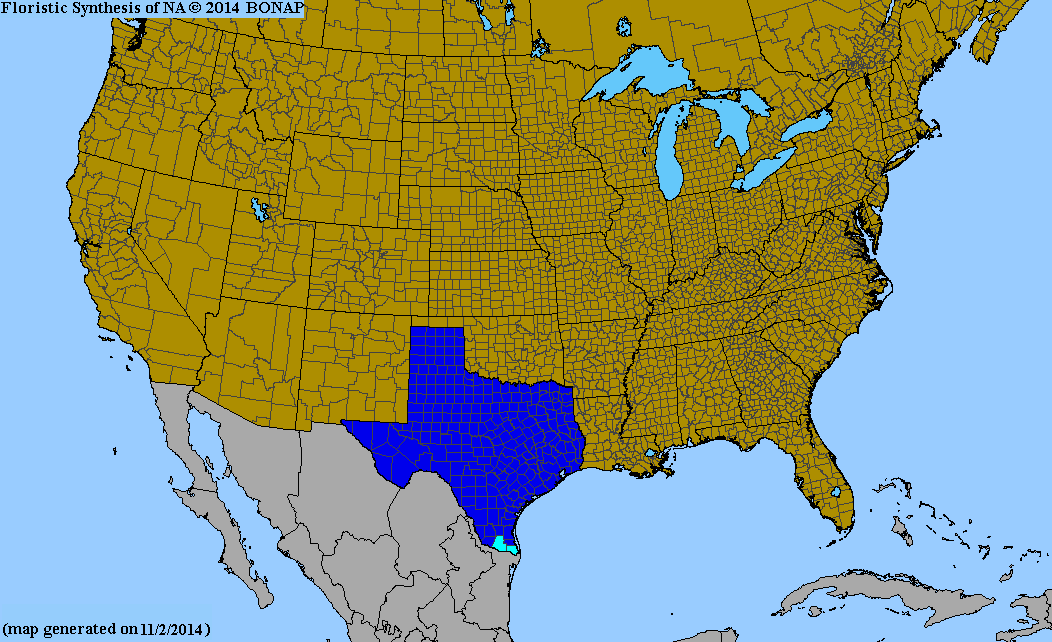
Isocarpha (pearlhead)[3] is a genus of flowering plants in the family Asteraceae.[4][5][6] They are native to Mexico, Central America, the West Indies, and northern South America, with the range of one species extending north into the United States.[7][8][9][10]
Classification
[edit]Although it is generally assigned to the tribe Eupatorieae, the flowers are unusual for that tribe. It is believed to have evolved from an ancestor which more closely resembles other Eupatorieae.[7]
- Species[2]
- Isocarpha atriplicifolia (L.) R.Br. ex DC. - Chiapas, Guerrero, Cuba, Hispaniola, Central America, Colombia, Venezuela
- Isocarpha fistulosa Keil & Stuessy - Peru, Ecuador
- Isocarpha megacephala Mattf. - eastern Brazil (Bahia, Pernambuco, Paraíba)
- Isocarpha microcephala (DC.) S.F.Blake - Peru, Ecuador
- Isocarpha oppositifolia (L.) Cass. - Mesoamerica, northern South America, West Indies, extreme southern Texas[11]
References
[edit]- ↑ Tropicos, Isocarpha R. Br.
- 1 2 Flann, C (ed) 2009+ Global Compositae Checklist[link removed]
- ↑ NRCS. "Isocarpha". PLANTS Database. United States Department of Agriculture (USDA). Retrieved 25 May 2015.
- ↑ Brown, Robert. 1817. Observations on the Natural Family of Plants called Compositae 110
- ↑ Tropicos, Isocarpha R. Br.
- ↑ "Isocarpha R. Brown". Flora of North America.
- 1 2 Keil, David J.; Stuessy, Tod F (1981). "Systematics of Isocarpha (Compositae: Eupatorieae)". Systematic Botany. 6 (3). American Society of Plant Taxonomists: 258. doi:10.2307/2418285. JSTOR 2418285.
- ↑ Weberling, F. H. E. & J. A. Lagos. 1960. Neue Blütenpflanzen für El Salvador - C.A. (Vorläufige Liste). Beitrage zur Biologie der Pflanzen 35(2): 177–201
- ↑ Turner, B. L. 1997. The Comps of Mexico: A systematic account of the family Asteraceae, vol. 1 – Eupatorieae. Phytologia Memoirs 11: i–iv, 1–272
- ↑ Keil, D. J. and T. F. Stuessy. 1981. Systematics of Isocarpha (Compositae: Eupatorieae). Systematic Botany 6: 258–287.
- ↑ Biota of North America Program 2013 county range map
 | This Eupatorieae article is a stub. You can help Wikipedia by adding missing information. |