


Isbell's zigzag theorem
Isbell's zigzag theorem, a theorem of abstract algebra characterizing the notion of a dominion, was introduced by American mathematician John R. Isbell in 1966.[1] Dominion is a concept in semigroup theory, within the study of the properties of epimorphisms. For example, let U be a subsemigroup of S containing U, the inclusion map is an epimorphism if and only if , furthermore, a map is an epimorphism if and only if .[2] The categories of rings and semigroups are examples of categories with non-surjective epimorphism, and the Zig-zag theorem gives necessary and sufficient conditions for determining whether or not a given morphism is epi.[3] Proofs of this theorem are topological in nature, beginning with Isbell (1966) for semigroups, and continuing by Philip (1974), completing Isbell's original proof.[3][4][5] The pure algebraic proofs were given by Howie (1976) and Storrer (1976).[3][4][note 1]

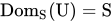


Statement
[edit]Zig-zag
[edit]
Zig-zag:[7][2][8][9][10][note 2] If U is a submonoid of a monoid (or a subsemigroup of a semigroup) S, then a system of equalities;

in which and , is called a zig-zag of length m in S over U with value d. By the spine of the zig-zag we mean the ordered (2m + 1)-tuple .



Dominion
[edit]Dominion:[5][6] Let U be a submonoid of a monoid (or a subsemigroup of a semigroup) S. The dominion is the set of all elements such that, for all homomorphisms coinciding on U, .


We call a subsemigroup U of a semigroup S closed if , and dense if .[2][12]
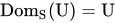
Isbell's zigzag theorem
[edit]Isbell's zigzag theorem:[13]
If U is a submonoid of a monoid S then if and only if either or there exists a zig-zag in S over U with value d that is, there is a sequence of factorizations of d of the form
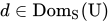


This statement also holds for semigroups.[7][14][9][4][10]
For monoids, this theorem can be written more concisely:[15][2][16]
Let S be a monoid, let U be a submonoid of S, and let . Then if and only if in the tensor product .

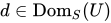


Application
[edit]- Let U be a commutative subsemigroup of a semigroup S. Then is commutative.[10]
- Every epimorphism from a finite commutative semigroup S to another semigroup T is surjective.[10]
- Inverse semigroups are absolutely closed.[7]
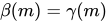
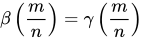
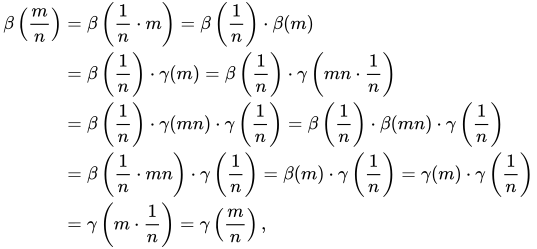
- Example of non-surjective epimorphism in the category of rings:[3] The inclusion is an epimorphism in the category of all rings and ring homomorphisms by proving that any pair of ring homomorphisms to any ring which agree on are fact equal.



A proof sketch for example of non-surjective epimorphism in the category of rings by using zig-zag |
|---|
|
We show that: Let to be ring homomorphisms, and , . When for all , then for all .
as required. |




See also
[edit]References
[edit]Citations
[edit]- ↑ (Isbell 1966)
- 1 2 3 4 (Howie 1996)
- 1 2 3 4 (Higgins 1988)
- 1 2 3 4 (Higgins 1990)
- 1 2 3 (Hoffman 2008)
- 1 2 (Storrer 1976)
- 1 2 3 (Howie & Isbell 1967, Theorem 2.3.)
- ↑ (Hall 1982)
- 1 2 (Higgins 1986)
- 1 2 3 4 (Higgins 2016)
- ↑ (Mitchell 1972)
- ↑ (Higgins 1983)
- ↑ (Howie 1996, Theorem 1.2.)
- ↑ (Higgins 1985)
- ↑ (Stenström 1971)
- ↑ (Renshaw 2002)
Bibliography
[edit]- Higgins, P. M. (1981). "Epis are onto for generalized inverse semigroups". Semigroup Forum. 23: 255–260. doi:10.1007/BF02676649. S2CID 122139547. Archived from the original on 2022-11-30. Retrieved 2023-08-20.
- Higgins, P. M. (1983). "The determination of all varieties consisting of absolutely closed semigroups". Proceedings of the American Mathematical Society. 87 (3): 419–421. doi:10.1090/S0002-9939-1983-0684630-8.
- Higgins, Peter M. (1986). "Completely semisimple semigroups and epimorphisms". Proceedings of the American Mathematical Society. 96 (3): 387–390. doi:10.1090/S0002-9939-1986-0822424-3. S2CID 123529614.
- Higgins, Peter M. (1988). "Epimorphisms and amalgams". Colloquium Mathematicum. 56: 1–17. doi:10.4064/cm-56-1-1-17. Archived from the original on 2023-07-29. Retrieved 2023-07-29.
- Higgins, Peter M. (1990). "A short proof of Isbell's zigzag theorem". Pacific Journal of Mathematics. 144 (1): 47–50. doi:10.2140/pjm.1990.144.47.
- Higgins, Peter M. (2016). "Ramsey's theorem in algebraic semigroup". First International Tainan-Moscow Algebra Workshop: Proceedings of the International Conference held at National Cheng Kung University Tainan, Taiwan, Republic of China, July 23–August 22, 1994. Walter de Gruyter GmbH & Co KG. ISBN 9783110883220. Archived from the original on August 13, 2023. Retrieved August 13, 2023.
- Hall, T. E. (1982). "Epimorphisms and dominions". Semigroup Forum. 24: 271–284. doi:10.1007/BF02572773. S2CID 120129600. Archived from the original on 2023-08-11. Retrieved 2023-08-10.
- Hall, T. E.; Jones, P. R. (1983). "Epis are onto for finite regular semigroups". Proceedings of the Edinburgh Mathematical Society. 26 (2): 151–162. doi:10.1017/S0013091500016850. S2CID 120509107.
- Isbell, John R. (1966). "Epimorphisms and Dominions". Proceedings of the Conference on Categorical Algebra. pp. 232–246. doi:10.1007/978-3-642-99902-4_9. ISBN 978-3-642-99904-8. Archived from the original on 2023-07-26. Retrieved 2023-07-26.[note 3]
- Howie, J.M; Isbell, J.R (1967). "Epimorphisms and dominions. II". Journal of Algebra. 6: 7–21. doi:10.1016/0021-8693(67)90010-5.
- Howie, John M. (1976). An introduction to semigroup theory. L.M.S. Monographs; 7. Academic Press. ISBN 9780123569509.
- Howie, John M. (1996). "Isbell's zigzag theorem and its consequences". Semigroup Theory and its Applications. pp. 81–92. doi:10.1017/CBO9780511661877.007. ISBN 9780521576697. Archived from the original on 2023-08-05. Retrieved 2023-08-05.
- Isbell, John R. (1969). "Epimorphisms and Dominions. IV". Journal of the London Mathematical Society: 265–273. doi:10.1112/jlms/s2-1.1.265.
- Hoffman, Piotr (2008). "A Proof of Isbell's Zigzag Theorem". Journal of the Australian Mathematical Society. 84 (2): 229–232. doi:10.1017/S1446788708000384. S2CID 55107808.
- Mitchell, Barry (1972). "The Dominion of Isbell". Transactions of the American Mathematical Society. 167: 319–331. doi:10.1090/S0002-9947-1972-0294441-0. JSTOR 1996142.
- Renshaw, James (2002). "On Free Products of Semigroups and a New Proof of Isbell's Zigzag Theorem". Journal of Algebra. 251 (1): 12–15. doi:10.1006/jabr.2002.9143.
- Stenström, Bo (1971). "Flatness and localization over monoids". Mathematische Nachrichten. 48 (1–6): 315–334. doi:10.1002/mana.19710480124.
- Storrer, H. (1976). "An algebraic proof of Isbell' s zigzag theorem". Semigroup Forum. 12: 83–88. doi:10.1007/BF02195912. S2CID 121208494. Archived from the original on 2022-07-17. Retrieved 2023-07-31.
Further reading
[edit]- Alam, Noor; Higgins, Peter M.; Khan, Noor Mohammad (2020). "Epimorphisms, dominions and -commutative semigroups". Semigroup Forum. 100 (2): 349–363. arXiv:1908.01813. doi:10.1007/s00233-019-10050-z. S2CID 202133305.
- Ahanger, Shabir Ahmad; Shah, Aftab Hussain (2020). "Epimorphisms, dominions and varieties of bands". Semigroup Forum. 100 (3): 641–650. doi:10.1007/s00233-019-10047-8. S2CID 253772526.
- Khan, N. M. (1985). "On saturated permutative varieties and consequences of permutation identities". Journal of the Australian Mathematical Society, Series A. 38 (2): 186–197. doi:10.1017/S1446788700023041. S2CID 122979127.
- Isbell, John R. (1968). "Epimorphisms and Dominions, III". American Journal of Mathematics. 90 (4): 1025–1030. doi:10.2307/2373286. JSTOR 2373286.
- Isbell, J. R. (1973). "Epimorphisms and dominions, V". Algebra Universalis. 3 (1): 318–320. doi:10.1007/BF02945133. S2CID 125292076.
- Scheiblich, E. (1976). "On epics and dominions of bands". Semigroup Forum. 13 (1): 103–114. doi:10.1007/BF02194926. S2CID 123580458.
- Philip, J.M (1974). "A proof of Isbell's zig-zag theorem". Journal of Algebra. 32 (2): 328–331. doi:10.1016/0021-8693(74)90141-0.
- Higgins, Peter M. (1985). "Epimorphisms, dominions and semigroups". Algebra Universalis. 21 (2–3): 225–233. doi:10.1007/BF01188058. S2CID 121142819.
- Higgins, Peter M. (1992). Techniques of Semigroup Theory. Oxford University Press. ISBN 9780198535775.
- Howie, John M. (1995). "Semigroup amalgams". Fundamentals of Semigroup Theory. Clarendon Press. ISBN 0-19-851194-9. MR 1455373. Zbl 0835.20077.
- Campercholi, Miguel (2018). "Dominions and Primitive Positive Functions". The Journal of Symbolic Logic. 83 (1): 40–54. doi:10.1017/jsl.2017.18. hdl:11336/88474. JSTOR 26600306. S2CID 19168037.

Footnote
[edit]- ↑ These pure algebraic proofs were based on the tensor product characterization of the dominant elements for monoid by Stenström (1971).[6][4]
- ↑ See Hoffman[5] or Mitchell[11] for commutative diagram.
- ↑ Some results were corrected in Isbell (1969).
External links
[edit]- Nicol, Andrew W. "WHAT IS... THE ZIGZAG THEOREM?" (PDF). S2CID 51745066.