


Irrationality sequence
In mathematics, a sequence of positive integers an is called an irrationality sequence if it has the property that for every sequence xn of positive integers, the sum of the series

exists (that is, it converges) and is an irrational number.[1][2] The problem of characterizing irrationality sequences was posed by Paul Erdős and Ernst G. Straus, who originally called the property of being an irrationality sequence "Property P".[3]
Examples
[edit]The powers of two whose exponents are powers of two, , form an irrationality sequence. However, although Sylvester's sequence

- 2, 3, 7, 43, 1807, 3263443, ...
(in which each term is one more than the product of all previous terms) also grows doubly exponentially, it does not form an irrationality sequence. For, letting for all gives



a series converging to a rational number. Likewise, the factorials, , do not form an irrationality sequence because the sequence given by for all leads to a series with a rational sum,



Growth rate
[edit]For any sequence an to be an irrationality sequence, it must grow at a rate such that
- .[4]
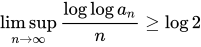
This includes sequences that grow at a more than doubly exponential rate as well as some doubly exponential sequences that grow more quickly than the powers of powers of two.[1]
Every irrationality sequence must grow quickly enough that
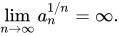
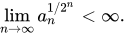
However, it is not known whether there exists such a sequence in which the greatest common divisor of each pair of terms is 1 (unlike the powers of powers of two) and for which
Related properties
[edit]Analogously to irrationality sequences, Hančl (1996) has defined a transcendental sequence to be an integer sequence an such that, for every sequence xn of positive integers, the sum of the series
exists and is a transcendental number.[6]
References
[edit]- 1 2 3 Guy, Richard K. (2004), "E24 Irrationality sequences", Unsolved problems in number theory (3rd ed.), Springer-Verlag, p. 346, ISBN 0-387-20860-7, Zbl 1058.11001.
- ↑ Erdős, P.; Graham, R. L. (1980), Old and new problems and results in combinatorial number theory, Monographies de L'Enseignement Mathématique, vol. 28, Geneva: Université de Genève L'Enseignement Mathématique, p. 128, MR 0592420.
- ↑ Erdős, P. (1975), "Some problems and results on the irrationality of the sum of infinite series" (PDF), Journal of Mathematical Sciences, 10: 1–7 (1976), MR 0539489.
- ↑ Hančl, Jaroslav (1991), "Expression of real numbers with the help of infinite series", Acta Arithmetica, 59 (2): 97–104, doi:10.4064/aa-59-2-97-104, MR 1133951
- ↑ Erdős, P. (1988), "On the irrationality of certain series: problems and results", New advances in transcendence theory (Durham, 1986) (PDF), Cambridge: Cambridge Univ. Press, pp. 102–109, MR 0971997.
- ↑ Hančl, Jaroslav (1996), "Transcendental sequences", Mathematica Slovaca, 46 (2–3): 177–179, MR 1427003.