


Intersecting chords theorem


In Euclidean geometry, the intersecting chords theorem, or just the chord theorem, is a statement that describes a relation of the four line segments created by two intersecting chords within a circle. It states that the products of the lengths of the line segments on each chord are equal. It is Proposition 35 of Book 3 of Euclid's Elements.
For example, for two chords AC and BD intersecting at point S, the following equation holds:
Proof
[edit]The theorem can be proven by triangle similarity and the inscribed angle theorem.


By the inscribed angle theorem, and , as each pair intercepts a common chord. Opposite angles at the point are also congruent, . Therefore and are similar triangles, with congruent corresponding angles.


The sides of one triangle are uniformly proportional to the corresponding sides of any similar triangle, so or, equivalently,


Related concepts
[edit]The converse is true as well. That is: If for two line segments AC and BD intersecting in S the equation above holds true, then their four endpoints A, B, C, D lie on a common circle. Or in other words, if the diagonals of a quadrilateral ABCD intersect in S and fulfill the equation above, then it is a cyclic quadrilateral.

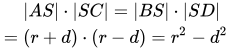
By applying the chord theorem to a third chord (a diameter) going through the circle's center M and point S, the following relationships can be made: where r is the radius of the circle and d is the distance between the circle's center M and point S.

Next to the tangent-secant theorem and the intersecting secants theorem, the intersecting chords theorem represents one of the three basic cases of a more general theorem about two intersecting lines and a circle: the power of a point theorem. The distance d from the circle's center M to the intersection point S is the absolute value of the power of S with respect to the circle.
References
[edit]- Paul Glaister: Intersecting Chords Theorem: 30 Years on. Mathematics in School, Vol. 36, No. 1 (Jan., 2007), p. 22 (JSTOR)
- Bruce Shawyer: Explorations in Geometry. World scientific, 2010, ISBN 9789813100947, p. 14
- Hans Schupp: Elementargeometrie. Schöningh, Paderborn 1977, ISBN 3-506-99189-2, p. 149 (German).
- Schülerduden - Mathematik I. Bibliographisches Institut & F.A. Brockhaus, 8. Auflage, Mannheim 2008, ISBN 978-3-411-04208-1, pp. 415-417 (German)
External links
[edit]- Intersecting Chords Theorem at cut-the-knot.org
- Intersecting Chords Theorem Archived 2020-12-01 at the Wayback Machine at proofwiki.org
- Weisstein, Eric W. "Chord". MathWorld.
- Two interactive illustrations: and

