


Intermembral index
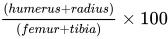
The intermembral index is a ratio used to compare limb proportions, expressed as a percentage.[1] It is equal to the length of forelimbs (humerus plus radius) divided by the length of the hind limbs (femur plus tibia) multiplied by 100,[2] otherwise written mathematically as:
The intermembral index is used frequently in primatology, since it helps predict primate locomotor patterns. For scores lower than 100, the forelimbs are shorter than the hind limbs, which is common in leaping primates and bipedal hominids. Quadrupedal primates tend to have scores around 100, while brachiating primates have scores significantly higher than 100. This information can also be used to predict locomotion patterns for extinct primates in cases where forelimb and hind limb fossils have been found.[1]
Primate species
[edit]Variation
[edit]In a diverse ethnic sample of 314 modern human skeletons covering African Pygmies, Andaman Islanders, Khoesan, Zulu, African Americans, Sami and Inuit the intermembral index was found to vary between 64 and 74.[4] A study published in 1937 found a range of variation between 64.5 and 79.2. This study found no link with humans of different groups with individuals from different ethnic groups showing similar scatter of variation.[5] Variation has also beem found in chimapanzees (100.1 - 113.7), gorillas (110.3 - 125.0), orangutan (135.0 -150.9), siamang (145.0 - 155.2), gibbon (120.5 - 137.1), and macque monkeys (83.0 - 91.0).[5]
References
[edit]- 1 2 Ankel-Simons, F. (2007). Primate Anatomy (3rd ed.). Academic Press. pp. 49–53. ISBN 978-0-12-372576-9.
- ↑ Conroy, G.C. (1990). Primate Evolution (1st ed.). New York: W.W. Norton and Co. ISBN 978-0-393-95649-8.
- ↑ Fleagle, John G. (2017-04-16), Intermembral Index, Wiley, p. 1–3, doi:10.1002/9781119179313.wbprim0189, ISBN 978-0-470-67337-9
- ↑ Jungers, William L. (2009). "Interlimb Proportions in Humans and Fossil Hominins: Variability and Scaling". Vertebrate Paleobiology and Paleoanthropology. Dordrecht: Springer Netherlands. pp. 93–98. doi:10.1007/978-1-4020-9980-9_9. ISBN 978-1-4020-9979-3. ISSN 1877-9077.
- 1 2 Schultz, Adolph H. (1937). "Proportions, Variability and Asymmetries of the Long Bones of the Limbs and the Clavicles in Man and Apes". Human Biology. 9 (3): 281–328. ISSN 0018-7143. JSTOR 41447326.
.png) | This primate-related article is a stub. You can help Wikipedia by adding missing information. |
 | This anatomy article is a stub. You can help Wikipedia by adding missing information. |