


// Workers AI · dad joke modeWhat did the inner form say? It's filled out.
In mathematics, an inner form of an algebraic group over a field is another algebraic group such that there exists an isomorphism between and defined over (this means that is a -form of ) and in addition, for every Galois automorphism the automorphism is an inner automorphism of (i.e. conjugation by an element of ).


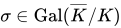


Through the correspondence between -forms and the Galois cohomology this means that is associated to an element of the subset where is the subgroup of inner automorphisms of .



Being inner forms of each other is an equivalence relation on the set of -forms of a given algebraic group.
A form which is not inner is called an outer form. In practice, to check whether a group is an inner or outer form one looks at the action of the Galois group on the Dynkin diagram of (induced by its action on , which preserves any torus and hence acts on the roots). Two groups are inner forms of each other if and only if the actions they define are the same.

For example, the -forms of are itself and the unitary groups and . The latter two are outer forms of , and they are inner forms of each other.


References
[edit]- Tits, Jacques (1966), "Classification of algebraic semisimple groups", in Borel, Armand; Mostow, George D. (eds.), Algebraic Groups and Discontinuous Subgroups (Proc. Sympos. Pure Math., Boulder, Colo., 1965), Providence, R.I.: American Mathematical Society, pp. 33–62, ISBN 978-0-8218-1409-3, MR 0224710
 | This abstract algebra–related article is a stub. You can help Wikipedia by adding missing information. |