


Increment theorem
In nonstandard analysis, a field of mathematics, the increment theorem states the following: Suppose a function y = f(x) is differentiable at x and that Δx is infinitesimal. Then for some infinitesimal ε, where


If then we may write which implies that , or in other words that is infinitely close to , or is the standard part of .

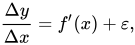


A similar theorem exists in standard Calculus. Again assume that y = f(x) is differentiable, but now let Δx be a nonzero standard real number. Then the same equation holds with the same definition of Δy, but instead of ε being infinitesimal, we have (treating x and f as given so that ε is a function of Δx alone).

See also
[edit]References
[edit]- Howard Jerome Keisler: Elementary Calculus: An Infinitesimal Approach. First edition 1976; 2nd edition 1986. This book is now out of print. The publisher has reverted the copyright to the author, who has made available the 2nd edition in .pdf format available for downloading at http://www.math.wisc.edu/~keisler/calc.html
- Robinson, Abraham (1996). Non-standard analysis (Revised ed.). Princeton University Press. ISBN 0-691-04490-2.
| History |  | |
|---|---|---|
| Related branches | ||
| Formalizations | ||
| Individual concepts | ||
| Mathematicians | ||
| Textbooks | ||