// Workers AI · dad joke modeWhat did Hymenoxys subintegra say? I'm a little dissected.
| Hymenoxys subintegra | |
|---|---|
 | |
Scientific classification  | |
| Kingdom: | Plantae |
| Clade: | Embryophytes |
| Clade: | Tracheophytes |
| Clade: | Angiosperms |
| Clade: | Eudicots |
| Clade: | Asterids |
| Order: | Asterales |
| Family: | Asteraceae |
| Genus: | Hymenoxys |
| Species: | H. subintegra |
| Binomial name | |
| Hymenoxys subintegra Cockerell 1904 | |
| Synonyms[1] | |
|
Actinea subintegra (Cockerell) S.F.Blake | |
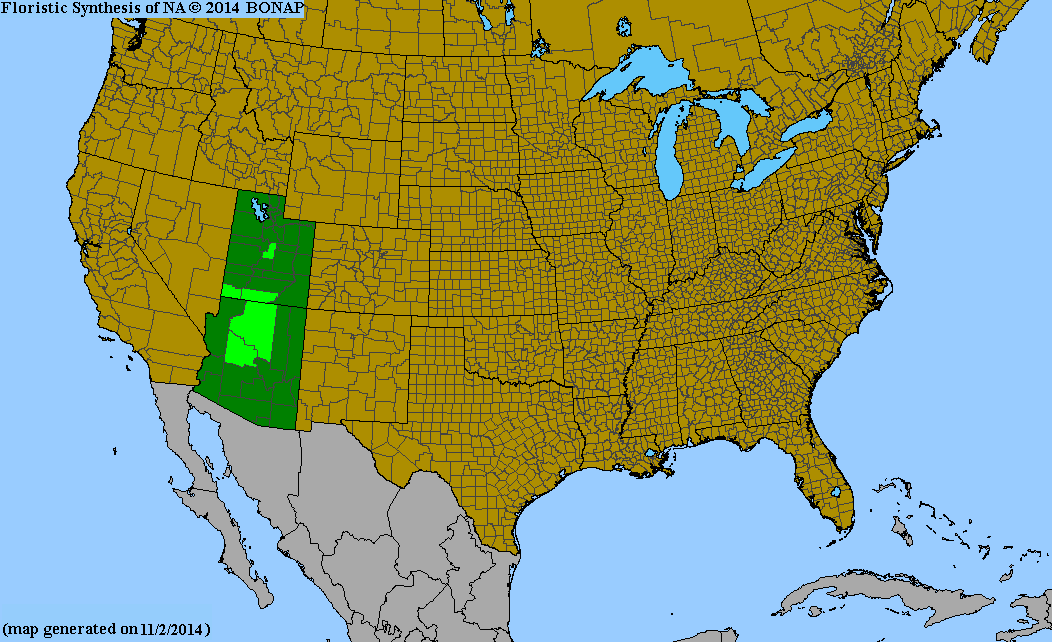
Hymenoxys subintegra is a North American species of flowering plant in the daisy family known by the common name Arizona rubberweed. It has been found only in the states of Arizona and Utah in the southwestern United States. Many of the populations lie inside Grand Canyon National Park, others in Kaibab National Forest.[2][3]
Hymenoxys subintegra grows in open areas, generally at the edges of forests at elevations of 2,100–2,800 meters (6,900–9,200 ft). It is a perennial herb up to 60 cm (2.0 ft) tall. One plant can produce 10–85 flower heads in a branching, flat-topped array. Each head has 10–16 yellow ray flowers and 50–100 tiny yellow disc flowers.[4][5]
References
[edit]- ↑ The Plant List, Hymenoxys subintegra Cockerell
- ↑ Biota of North America Program 2014 distribution map
- ↑ SEINet, Southwestern Biodiversity, Arizona chapter photos, distribution map, description
- ↑ Flora of North America, Hymenoxys subintegra Cockerell, 1904. Arizona rubberweed
- ↑ Cockerell, Theodore Dru Alison. 1904. Bulletin of the Torrey Botanical Club 31(9): 480–481