


// Workers AI · dad joke modeWhat did Hercosestria say to its date? "You're a stripe above the rest.
| Hercosestria Temporal range: | |
|---|---|
 | |
| Hercosestria cribrosa (multiple individuals) | |
Scientific classification  | |
| Kingdom: | Animalia |
| Phylum: | Brachiopoda |
| Class: | †Strophomenata |
| Order: | †Productida |
| Family: | †Hercosiidae |
| Genus: | †Hercosestria Cooper & Grant, 1969 |
| Species | |
| |
Hercosestria is an extinct genus of brachiopods from the Lower and Middle Permian.[1] They were important reef-forming organisms because of their conical shapes, attaching spines, and gregarious habits.[2] It is related to Richthofenia.[3] Species of the genus have been found in Texas (H. cribrosa and H. laevis) and Guatemala (H. notialis).
References
[edit]
- ↑ Paleobiology Database. "Hercosestria cribrosa". Retrieved 11 January 2012.
- ↑ Weidlich, O. (2002). "Permian reefs re-examined: extrinsic control mechanisms of gradual and abrupt changes during 40 my of reef evolution". Geobios. 35 (Supplement 1): 287–294. Bibcode:2002Geobi..35..287W. doi:10.1016/s0016-6995(02)00066-9.
- ↑ Cooper, G.A.; Grant, R.E. (1969). "New Permian brachiopods from west Texas" (PDF). Smithsonian Contributions to Paleobiology. 1: 1–20. doi:10.5479/si.00810266.1.1.
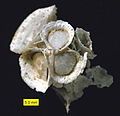 Hercosestria cribrosa Cooper & Grant 1969 (Roadian, Guadalupian, Middle Permian); Glass Mountains, Texas.
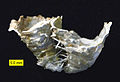 Hercosestria cribrosa Cooper & Grant 1969 (Roadian, Guadalupian, Middle Permian); Glass Mountains, Texas.


_silhouette.svg) | This protostome-related article is a stub. You can help Wikipedia by adding missing information. |