


// Workers AI · dad joke modeIs a hemicompact space half full or half compact?
In mathematics, in the field of topology, a Hausdorff topological space is said to be hemicompact if it has a sequence of compact subsets such that every compact subset of the space lies inside some compact set in the sequence.[1] This forces the union of the sequence to be the whole space, because every point is compact and hence must lie in one of the compact sets.
Examples
[edit]- Every compact space is hemicompact.
- The real line is hemicompact.
- Every locally compact Lindelöf space is hemicompact.
Properties
[edit]Every hemicompact space is σ-compact[2] and if in addition it is first countable then it is locally compact. If a hemicompact space is weakly locally compact, then it is exhaustible by compact sets.
Applications
[edit]If is a hemicompact space, then the space of all continuous functions to a metric space with the compact-open topology is metrizable.[3] To see this, take a sequence of compact subsets of such that every compact subset of lies inside some compact set in this sequence (the existence of such a sequence follows from the hemicompactness of ). Define pseudometrics



Then
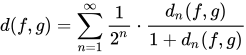
defines a metric on which induces the compact-open topology.
See also
[edit]Notes
[edit]- ↑ Willard 2004, Problem set in section 17.
- ↑ Willard 2004, p. 126
- ↑ Conway 1990, Example IV.2.2.
References
[edit]- Willard, Stephen (2004). General Topology. Dover Publications. ISBN 0-486-43479-6.
- Conway, J. B. (1990). A Course in Functional Analysis. Graduate Texts in Mathematics. Vol. 96. Springer Verlag. ISBN 0-387-97245-5.
External links
[edit]- hemicompact space on nLab
- hemicompact on π-Base
 | This topology-related article is a stub. You can help Wikipedia by adding missing information. |