The two-component helicity eigenstates
ξ
λ
{\displaystyle \xi _{\lambda }}
σ
⋅
p
^
ξ
λ
(
p
^
)
=
λ
ξ
λ
(
p
^
)
{\displaystyle \sigma \cdot {\hat {p}}\xi _{\lambda }\left({\hat {p}}\right)=\lambda \xi _{\lambda }\left({\hat {p}}\right)\,}
where
σ
{\displaystyle \sigma \,}
Pauli matrices ,
p
^
{\displaystyle {\hat {p}}\,}
λ
=
±
1
{\displaystyle \lambda =\pm 1\,}
p
^
{\displaystyle {\hat {p}}\,}
To say more about the state,
ξ
λ
{\displaystyle \xi _{\lambda }\,}
fermion four-momentum :
p
μ
=
(
E
,
|
p
→
|
sin
θ
cos
ϕ
,
|
p
→
|
sin
θ
sin
ϕ
,
|
p
→
|
cos
θ
)
{\displaystyle p^{\mu }=\left(E,\left|{\vec {p}}\right|\sin {\theta }\cos {\phi },\left|{\vec {p}}\right|\sin {\theta }\sin {\phi },\left|{\vec {p}}\right|\cos {\theta }\right)\,}
Then one can say the two helicity eigenstates are
ξ
+
1
(
p
→
)
=
1
2
|
p
→
|
(
|
p
→
|
+
p
z
)
(
|
p
→
|
+
p
z
p
x
+
i
p
y
)
=
(
cos
θ
2
e
i
ϕ
sin
θ
2
)
{\displaystyle \xi _{+1}({\vec {p}})={\frac {1}{\sqrt {2\left|{\vec {p}}\right|\left(\left|{\vec {p}}\right|+p_{z}\right)}}}{\begin{pmatrix}\left|{\vec {p}}\right|+p_{z}\\p_{x}+ip_{y}\end{pmatrix}}={\begin{pmatrix}\cos {\frac {\theta }{2}}\\e^{i\phi }\sin {\frac {\theta }{2}}\end{pmatrix}}\,}
and
ξ
−
1
(
p
→
)
=
1
2
|
p
→
|
(
|
p
→
|
+
p
z
)
(
−
p
x
+
i
p
y
|
p
→
|
+
p
z
)
=
(
−
e
−
i
ϕ
sin
θ
2
cos
θ
2
)
{\displaystyle \xi _{-1}({\vec {p}})={\frac {1}{\sqrt {2|{\vec {p}}|(|{\vec {p}}|+p_{z})}}}{\begin{pmatrix}-p_{x}+ip_{y}\\\left|{\vec {p}}\right|+p_{z}\end{pmatrix}}={\begin{pmatrix}-e^{-i\phi }\sin {\frac {\theta }{2}}\\\cos {\frac {\theta }{2}}\end{pmatrix}}\,}
These can be simplified by defining the z-axis such that the momentum direction is either parallel or anti-parallel, or rather:
z
^
=
±
p
^
{\displaystyle {\hat {z}}=\pm {\hat {p}}\,}
In this situation the helicity eigenstates are for when the particle momentum is
p
^
=
+
z
^
{\displaystyle {\hat {p}}=+{\hat {z}}\,}
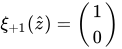
ξ
+
1
(
z
^
)
=
(
1
0
)
{\displaystyle \xi _{+1}({\hat {z}})={\begin{pmatrix}1\\0\end{pmatrix}}\,}
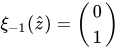
ξ
−
1
(
z
^
)
=
(
0
1
)
{\displaystyle \xi _{-1}({\hat {z}})={\begin{pmatrix}0\\1\end{pmatrix}}\,}
then for when momentum is
p
^
=
−
z
^
{\displaystyle {\hat {p}}=-{\hat {z}}\,}
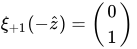
ξ
+
1
(
−
z
^
)
=
(
0
1
)
{\displaystyle \xi _{+1}(-{\hat {z}})={\begin{pmatrix}0\\1\end{pmatrix}}\,}
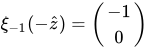
ξ
−
1
(
−
z
^
)
=
(
−
1
0
)
{\displaystyle \xi _{-1}(-{\hat {z}})={\begin{pmatrix}-1\\0\end{pmatrix}}\,}
[ edit ] A fermion 4-component wave function ,
ψ
{\displaystyle \psi \,}
ψ
(
x
)
=
∫
d
3
p
(
2
π
)
3
2
E
∑
λ
±
1
(
a
^
p
λ
u
λ
(
p
)
e
−
i
p
⋅
x
+
b
^
p
λ
v
λ
(
p
)
e
i
p
⋅
x
)
{\displaystyle \psi (x)=\int {{\frac {d^{3}p}{(2\pi )^{3}{\sqrt {2E}}}}\sum _{\lambda \pm 1}{\left({\hat {a}}_{p}^{\lambda }u_{\lambda }(p)e^{-ip\cdot x}+{\hat {b}}_{p}^{\lambda }v_{\lambda }(p)e^{ip\cdot x}\right)}}\,}
where
a
^
p
λ
{\displaystyle {\hat {a}}_{p}^{\lambda }\,}
b
^
p
λ
{\displaystyle {\hat {b}}_{p}^{\lambda }\,}
creation and annihilation operators , and
u
λ
(
p
)
{\displaystyle u_{\lambda }(p)\,}
v
λ
(
p
)
{\displaystyle v_{\lambda }(p)\,}
Dirac spinors for a fermion and anti-fermion respectively. Put it more explicitly, the Dirac spinors in the helicity basis for a fermion is
u
λ
(
p
)
=
(
u
−
1
u
+
1
)
=
(
E
−
λ
|
p
→
|
χ
λ
(
p
^
)
E
+
λ
|
p
→
|
χ
λ
(
p
^
)
)
{\displaystyle u_{\lambda }(p)={\begin{pmatrix}u_{-1}\\u_{+1}\end{pmatrix}}={\begin{pmatrix}{\sqrt {E-\lambda \left|{\vec {p}}\right|}}\chi _{\lambda }({\hat {p}})\\{\sqrt {E+\lambda \left|{\vec {p}}\right|}}\chi _{\lambda }({\hat {p}})\end{pmatrix}}\,}
and for an anti-fermion,
v
λ
(
p
)
=
(
v
+
1
v
−
1
)
=
(
−
λ
E
+
λ
|
p
→
|
χ
−
λ
(
p
^
)
λ
E
−
λ
|
p
→
|
χ
−
λ
(
p
^
)
)
{\displaystyle v_{\lambda }(p)={\begin{pmatrix}v_{+1}\\v_{-1}\end{pmatrix}}={\begin{pmatrix}-\lambda {\sqrt {E+\lambda \left|{\vec {p}}\right|}}\chi _{-\lambda }({\hat {p}})\\\lambda {\sqrt {E-\lambda \left|{\vec {p}}\right|}}\chi _{-\lambda }({\hat {p}})\end{pmatrix}}}
Spin-1 wavefunctions [ edit ] The plane wave expansion is
ψ
(
x
)
=
∫
d
3
p
(
2
π
)
3
2
E
∑
λ
=
0
3
(
a
^
p
,
λ
ϵ
λ
(
p
)
e
−
i
p
⋅
x
+
a
^
p
,
λ
†
ϵ
λ
∗
(
p
)
e
i
p
⋅
x
)
{\displaystyle \psi (x)=\int {{\frac {d^{3}p}{(2\pi )^{3}{\sqrt {2E}}}}\sum _{\lambda =0}^{3}\left({\hat {a}}_{p,\lambda }\epsilon _{\lambda }(p)e^{-ip\cdot x}+{\hat {a}}_{p,\lambda }^{\dagger }\epsilon _{\lambda }^{*}(p)e^{ip\cdot x}\right)}\,}
For a vector boson with mass m and a four-momentum
q
μ
=
(
E
,
q
x
,
q
y
,
q
z
)
{\displaystyle q^{\mu }=(E,q_{x},q_{y},q_{z})}
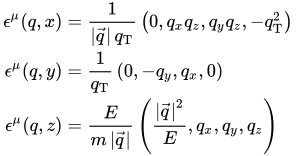
polarization vectors quantized with respect to its momentum direction can be defined as
ϵ
μ
(
q
,
x
)
=
1
|
q
→
|
q
T
(
0
,
q
x
q
z
,
q
y
q
z
,
−
q
T
2
)
ϵ
μ
(
q
,
y
)
=
1
q
T
(
0
,
−
q
y
,
q
x
,
0
)
ϵ
μ
(
q
,
z
)
=
E
m
|
q
→
|
(
|
q
→
|
2
E
,
q
x
,
q
y
,
q
z
)
{\displaystyle {\begin{aligned}\epsilon ^{\mu }(q,x)&={\frac {1}{\left|{\vec {q}}\right|q_{\text{T}}}}\left(0,q_{x}q_{z},q_{y}q_{z},-q_{\text{T}}^{2}\right)\\\epsilon ^{\mu }(q,y)&={\frac {1}{q_{\text{T}}}}\left(0,-q_{y},q_{x},0\right)\\\epsilon ^{\mu }(q,z)&={\frac {E}{m\left|{\vec {q}}\right|}}\left({\frac {\left|{\vec {q}}\right|^{2}}{E}},q_{x},q_{y},q_{z}\right)\end{aligned}}}
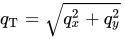
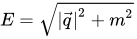
where
q
T
=
q
x
2
+
q
y
2
{\displaystyle q_{\text{T}}={\sqrt {q_{x}^{2}+q_{y}^{2}}}\,}
E
=
|
q
→
|
2
+
m
2
{\displaystyle E={\sqrt {|{\vec {q}}|^{2}+m^{2}}}\,}