


// Workers AI · dad joke modeWhy was heat in circuits so popular? It had a burning desire.
The heat dissipation in integrated circuits problem has gained increasing interest in recent years due to the miniaturization of semiconductor devices. The temperature increase becomes relevant for cases of relatively small-cross-sections wires, because such temperature increase may affect the normal behavior of semiconductor devices.
Joule heating
[edit]Joule heating is a predominant heat mechanism for heat generation in integrated circuits[1] and is an undesired effect.
Propagation
[edit]The governing equation of the physics of the problem to be analyzed is the heat diffusion equation. It relates the flux of heat in space, its variation in time and the generation of power.
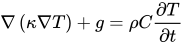
Where is the thermal conductivity, is the density of the medium, is the specific heat


the thermal diffusivity and is the rate of heat generation per unit volume. Heat diffuses from the source following equation ([eq:diffusion]) and solution in a homogeneous medium of ([eq:diffusion]) has a Gaussian distribution.

See also
[edit]References
[edit]- ↑ T. Bechtold, E. V. Rudnyi and J. G Korvink, "Dynamic electro-thermal simulation of microsystems—a review," Journal of Micromechanics and Microengineering. vol. 15, pp. R17–R31, 2005
Further reading
[edit]- Ogrenci-Memik, Seda (2015). Heat Management in Integrated circuits: On-chip and system-level monitoring and cooling. London, United Kingdom: The Institution of Engineering and Technology. ISBN 9781849199353. OCLC 934678500.