


Hamming scheme
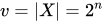
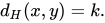
The Hamming scheme, named after Richard Hamming, is also known as the hyper-cubic association scheme, and it is the most important example for coding theory.[1][2][3] In this scheme the set of binary vectors of length and two vectors are -th associates if they are Hamming distance apart.


Recall that an association scheme is visualized as a complete graph with labeled edges. The graph has vertices, one for each point of and the edge joining vertices and is labeled if and are -th associates. Each edge has a unique label, and the number of triangles with a fixed base labeled having the other edges labeled and is a constant depending on but not on the choice of the base. In particular, each vertex is incident with exactly edges labeled ; is the valency of the relation The in a Hamming scheme are given by


Here, and The matrices in the Bose-Mesner algebra are matrices, with rows and columns labeled by vectors In particular the -th entry of is if and only if


See also
[edit]References
[edit]- ↑ P. Delsarte and V. I. Levenshtein, “Association schemes and coding theory,“ IEEE Trans. Inf. Theory, vol. 44, no. 6, pp. 2477–2504, 1998.
- ↑ P. Camion, "Codes and Association Schemes: Basic Properties of Association Schemes Relevant to Coding," in Handbook of Coding Theory, V. S. Pless and W. C. Huffman, Eds., Elsevier, The Netherlands, 1998.
- ↑ F. J. MacWilliams and N. J. A. Sloane, The Theory of Error-Correcting Codes, Elsevier, New York, 1978.