


Hadamard factorization theorem
In mathematics, and particularly in the field of complex analysis, the Hadamard factorization theorem asserts that every entire function with finite order can be represented as a product involving its zeroes and an exponential of a polynomial. It is named for Jacques Hadamard.
The theorem may be viewed as an extension of the fundamental theorem of algebra, which asserts that every polynomial may be factored into linear factors, one for each root. It is closely related to Weierstrass factorization theorem, which does not restrict to entire functions with finite orders.
Formal statement
[edit]| Mathematical analysis → Complex analysis |
| Complex analysis |
|---|
 |

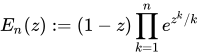
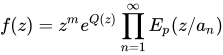
Define the Hadamard canonical factors Entire functions of finite order have Hadamard's canonical representation:[1]where are those roots of that are not zero (), is the order of the zero of at (the case being taken to mean ), a polynomial (whose degree we shall call ), and is the smallest non-negative integer such that the seriesconverges. The non-negative integer is called the genus of the entire function . In this notation,In other words: If the order is not an integer, then is the integer part of . If the order is a positive integer, then there are two possibilities: or .




![{\displaystyle g=[\rho ]}](https://wikimedia.org/api/rest_v1/media/math/render/svg/0daa8fd34b7cfa4ebcc0b39ec866af4d4a76a48d)


For example, , and are entire functions of genus .


Convergence exponent
[edit]Define the convergence exponent of the roots of as the following:[2]where is the number of roots with modulus . In other words, we have an asymptotic bound on the growth behavior of the number of roots of the function:It's clear that .


Theorem:[3] If is an entire function with infinitely many roots, thenNote: These two equalities are purely about the limit behaviors of a real number sequence that diverges to infinity. It does not involve complex analysis.


Proposition:[2] , by Jensen's formula.

Applications
[edit]With Hadamard factorization we can prove some special cases of Picard's little theorem.
Theorem:[4] If is entire, nonconstant, and has finite order, then it assumes either the whole complex plane or the plane minus a single point.
Proof: If does not assume value , then by Hadamard factorization, for a nonconstant polynomial . By the fundamental theorem of algebra, assumes all values, so assumes all nonzero values.

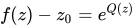

Theorem:[4] If is entire, nonconstant, and has finite, non-integer order , then it assumes the whole complex plane infinitely many times.
Proof: For any , it suffices to prove has infinitely many roots. Expand to its Hadamard representation . If the product is finite, then is an integer.




Proof
[edit]The proof below follows Conway's treatment of Hadamard's factorization theorem.[5]
Let be an entire function of finite order . If has a zero of order at the origin, write

where is entire and . Multiplying by a nonzero constant does not affect the order, so it is enough to prove the theorem under the normalization . The factor can then be restored at the end.


Let be the nonzero zeros of , repeated according to multiplicity and ordered so that


Let . The first step is to show that the zero sequence has exponent of convergence at most , and in particular that


Indeed, let denote the number of zeros of in , counted with multiplicity. By Jensen's formula, one obtains an estimate of the form


where

Since has order , for every and all sufficiently large ,


Choosing so small that , it follows that


Since , this gives


for all sufficiently large and some constant . Therefore


and the exponent on the right is greater than . Hence

Consequently the canonical product

converges locally uniformly and defines an entire function whose zeros are precisely the zeros , with the same multiplicities. Thus


is a zero-free entire function. Since the complex plane is simply connected, there is an entire function such that


Hence

It remains to prove that is a polynomial of degree at most . For this Conway uses the following logarithmic-derivative lemma.
Lemma. If is an entire function of finite order , , and is an integer with , then, away from the zeros of ,


In the present case , so . Applying the lemma to gives
On the other hand, since ,


For a single elementary factor,

After differentiating times, the polynomial part vanishes, and hence

Comparing the two formulas gives

Therefore is a polynomial of degree at most .
Restoring the zero at the origin, one obtains

where is a polynomial of degree at most . Thus the genus of is finite and is at most . This is Hadamard's factorization theorem.
References
[edit]- ↑ Conway, J. B. (1995), Functions of One Complex Variable I (2nd ed.), springer.com: Springer, ISBN 0-387-90328-3
- 1 2 Levin, B. Ya (1996). Lectures on entire functions. Yurii Lyubarskii, M. Sodin, Vadim Tkachenko. Providence, Rhode Island: American Mathematical Society. ISBN 978-0-8218-3316-2.
- ↑ Markushevich, Aleksei Ivanovich (1965), Theory of Functions of a Complex Variable. Volume II, Prentice-Hall, ISBN 9780139138140
- 1 2 Conway, John B. (1978). Functions of One Complex Variable I. Graduate Texts in Mathematics. Vol. 11. New York, NY: Springer New York. doi:10.1007/978-1-4612-6313-5. ISBN 978-0-387-94234-6. Chapter 11, Theorems 3.6, 3.7.
- ↑ Conway 1978, Ch. XI, §3.