// Workers AI · dad joke modeWhat did Habenaria repens say? "I'm a little 'wilted'.
| Habenaria repens | |
|---|---|
.jpg) | |
Scientific classification  | |
| Kingdom: | Plantae |
| Clade: | Embryophytes |
| Clade: | Tracheophytes |
| Clade: | Angiosperms |
| Clade: | Monocots |
| Order: | Asparagales |
| Family: | Orchidaceae |
| Subfamily: | Orchidoideae |
| Genus: | Habenaria |
| Species: | H. repens |
| Binomial name | |
| Habenaria repens Nutt. (1818) | |
| Synonyms[2] | |
| |

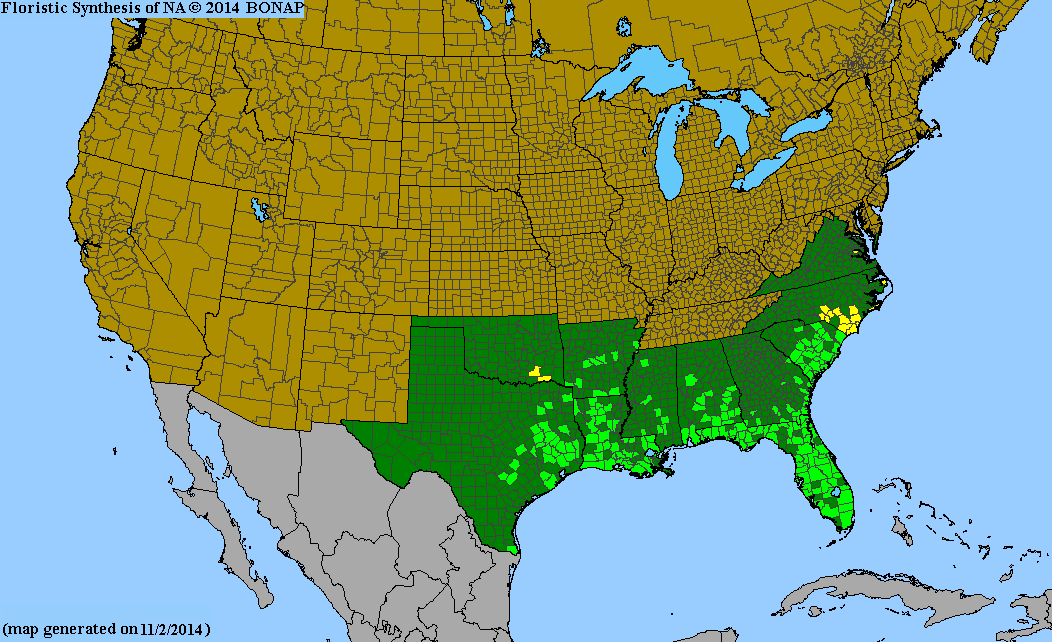
Habenaria repens, commonly called the water-spider bog orchid or the floating orchid, is an orchid species widespread across Latin America from Mexico and the West Indies south to Argentina, as well as in the Southeastern United States from Texas and Oklahoma east to Florida and the Carolinas plus an isolated population in Virginia.[2][3][4][5][6][7][8][9][10][11][12][13]
A phenolic compound called habenariol can be found in H. repens.[14] It acts as a feeding deterrent.[15]
Varieties
[edit]Two taxonomic varieties are accepted as of June 2014:[2]
- Habenaria repens var. maxillaris (Lindl.) Garay - Guatemala, Colombia, Ecuador, Peru, Bolivia
- Habenaria repens var. repens - most of species range including those regions listed for var. maxillaris
References
[edit]- 1 2 NatureServe. "Habenaria repens". NatureServe Explorer. Arlington, Virginia. Retrieved 19 March 2025.
- 1 2 3 Kew World Checklist of Selected Plant Families[permanent dead link]
- ↑ Flora of North America v 26 p 582, Habenaria repens Nuttall, Gen. N. Amer. Pl. 2: 190. 1818.
- ↑ Biota of North America Program, county distribution map
- ↑ Hammel, B.E. & al. (2003). Manual de Plantas de Costa Rica 3: 1-884. Missouri Botanical Garden Press, St. Louis.
- ↑ Nelson Sutherland, C.H. (2008). Catálogo de las plantes vasculares de Honduras. Espermatofitas: 1-1576. SERNA/Guaymuras, Tegucigalpa, Honduras.
- ↑ Hokche, O., Berry, P.E. & Huber, O. (eds.) (2008). Nuevo Catálogo de la Flora Vascular de Venezuela: 1-859. Fundación Instituto Botánico de Venezuela.
- ↑ Gonzáles Tamayo, J.R. & Hernández Hernández, L. (2010). Las Orquídeas del occidente de México 1: 1-303. Coecytjal.
- ↑ Schinini, A (2010). "Orquídeas nativas del Paraguay". Rojasiana. 9: 1–316.
- ↑ Ferreira, A.W.C., Lima, M.I.S. & Pansarin, E.R. (2010). Orchidaceae na região central de São Paulo, Brasil. Rodriguésia; Revista do Instituto de Biologia Vegetal, Jardim Botânico e Estaçao Biologica do Itatiaya 61: 243-259.
- ↑ Batista, J.A.N.; de Bem Bianchetti, L.; González-Tamayo, R.; Figueroa, X.M.C.; Cribb, P.J. (2011). "A synopsis of New World Habenaria (Orchidaceae) II". Harvard Papers in Botany. 16: 233–273.
- ↑ Baptista, J.A.N.; Menini Neto, L.; Vale, A.A. (2012). "Three new species, four new records and an updated checklist of Habenaria (Orchidaceae) from Rio Grande do Sul, Brazil". Nordic Journal of Botany. 30: 277–290.
- ↑ Acevedo-Rodríguez, P.; Strong, M.T. (2012). "Catalogue of seed plants of the West Indies". Smithsonian Contributions to Botany. 98: 1–1192.
- ↑ Johnson, MK; Alexander, KE; Lindquist, N; Loo, G (1999). "A phenolic antioxidant from the freshwater orchid, Habenaria repens". Comp Biochem Physiol C. 122 (2): 211–214. PMID 10190047.
- ↑ Wilson, D.M; Fenical, W; Hay, M.E; Lindquist, N; Bolser, R (1999). "Habenariol, a freshwater feeding deterrent from the aquatic orchid Habenaria repens (Orhicaceae)". Phytochemistry. 50: 1333–1336. doi:10.1016/s0031-9422(98)00340-9.
External links
[edit] Media related to Habenaria repens at Wikimedia Commons
 Data related to Water-spider bog orchid (Habenaria repens) at Wikispecies
- Aquatic and Invasive Plant Identification Series by the UF/IFAS at www.youtube.com
- plants.usda.gov
- plants.ifas.ufl.edu Archived 2015-08-09 at the Wayback Machine
- www.efloras.org