


Generalized Appell polynomials
 | This article includes a list of references, related reading, or external links, but its sources remain unclear because it lacks inline citations. (May 2024) |
In mathematics, a polynomial sequence has a generalized Appell representation if the generating function for the polynomials takes on a certain form:


where the generating function or kernel is composed of the series

- with
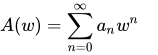

and
- and all
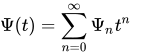

and
- with
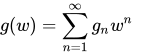

Given the above, it is not hard to show that is a polynomial of degree .


Boas–Buck polynomials are a slightly more general class of polynomials.
Special cases
[edit]- The choice of gives the class of Brenke polynomials.
- The choice of results in the Sheffer sequence of polynomials, which include the general difference polynomials, such as the Newton polynomials.
- The combined choice of and gives the Appell sequence of polynomials.


Explicit representation
[edit]The generalized Appell polynomials have the explicit representation
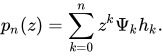
The constant is
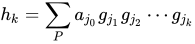
where this sum extends over all compositions of into parts; that is, the sum extends over all such that



For the Appell polynomials, this becomes the formula
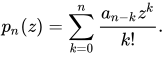
Recursion relation
[edit]Equivalently, a necessary and sufficient condition that the kernel can be written as with is that



where and have the power series



and

Substituting
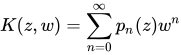
immediately gives the recursion relation
![{\displaystyle z^{n+1}{\frac {d}{dz}}\left[{\frac {p_{n}(z)}{z^{n}}}\right]=-\sum _{k=0}^{n-1}c_{n-k-1}p_{k}(z)-z\sum _{k=1}^{n-1}b_{n-k}{\frac {d}{dz}}p_{k}(z).}](https://wikimedia.org/api/rest_v1/media/math/render/svg/50fa5220f132f927db5f328de38bccc5d8f8fa76)
For the special case of the Brenke polynomials, one has and thus all of the , simplifying the recursion relation significantly.

See also
[edit]
References
[edit]- Ralph P. Boas, Jr. and R. Creighton Buck, Polynomial Expansions of Analytic Functions (Second Printing Corrected), (1964) Academic Press Inc., Publishers New York, Springer-Verlag, Berlin. Library of Congress Card Number 63-23263.
- Brenke, William C. (1945). "On generating functions of polynomial systems". American Mathematical Monthly. 52 (6): 297–301. doi:10.2307/2305289. JSTOR 2305289.
- Huff, W. N. (1947). "The type of the polynomials generated by f(xt) φ(t)". Duke Mathematical Journal. 14 (4): 1091–1104. doi:10.1215/S0012-7094-47-01483-X.
 | This polynomial-related article is a stub. You can help Wikipedia by adding missing information. |