


Gaillardia suavis
| Gaillardia suavis | |
|---|---|
 | |
Scientific classification  | |
| Kingdom: | Plantae |
| Clade: | Embryophytes |
| Clade: | Tracheophytes |
| Clade: | Angiosperms |
| Clade: | Eudicots |
| Clade: | Asterids |
| Order: | Asterales |
| Family: | Asteraceae |
| Genus: | Gaillardia |
| Species: | G. suavis |
| Binomial name | |
| Gaillardia suavis | |
| Synonyms[1] | |
| |
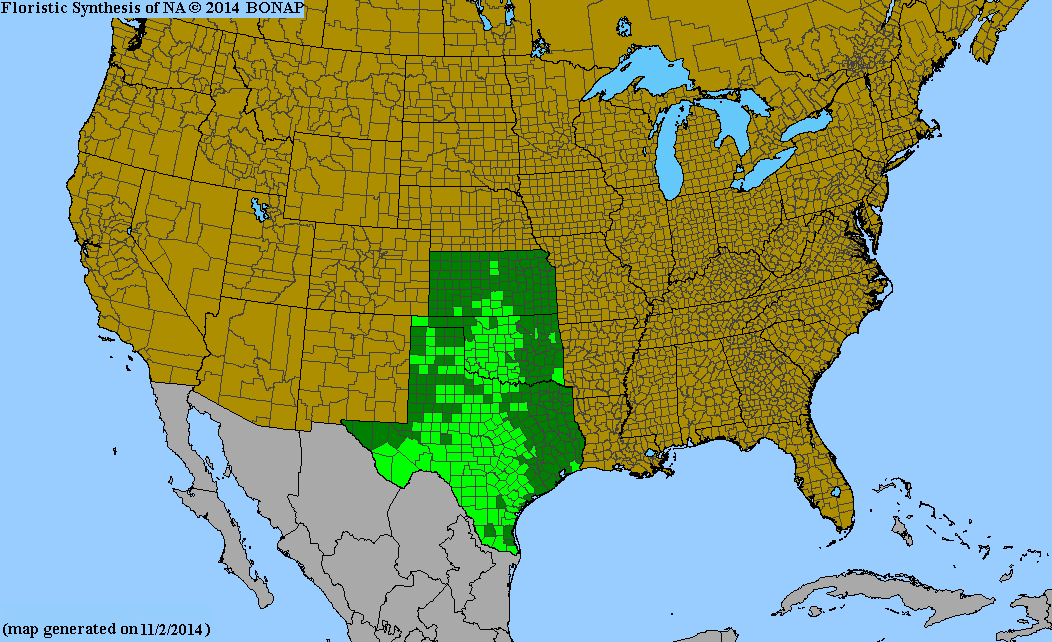
Gaillardia suavis is a species of flowering plant in the family Asteraceae, common names pincushion daisy[2] and perfumeballs.[3] It is native to northern Mexico (Coahuila, Nuevo León, Tamaulipas)[4] and the southern Great Plains of the United States (Kansas, Oklahoma, Texas).[5]
Gaillardia suavis grows in limestone or sandy soils in prairies, desert scrub, or open juniper woodlands. It is a perennial herb up to 80 cm (31 in) tall, with leaves crowded around the base rather than borne on the stem. Each flower head is on its own flower stalk up to 75 cm (30 in) long. Each head generally has 7-10 red or purple ray flowers, though some heads have no ray flowers. The center of the head has 40-100 pink or purple disc flowers.[6]
References
[edit]- ↑ The Plant List, Gaillardia suavis (A.Gray & Engelm.) Britton & Rusby
- ↑ Excerpts from Jim Conrad's Naturalist Newsletter, Backyard Nature, Pincushion Daisies includes photos
- ↑ NRCS. "Gaillardia suavis". PLANTS Database. United States Department of Agriculture (USDA). Retrieved 16 July 2015.
- ↑ Turner, B. L. 2013. The comps of Mexico. A systematic account of the family Asteraceae (chapter 11: tribe Helenieae). Phytologia Memoirs 16: 1–100
- ↑ Biota of North America Program 2014 county distribution map
- ↑ Flora of North America, Gaillardia suavis (A. Gray & Engelmann) Britton & Rusby, 1887.
External links
[edit]
 | This Helenieae article is a stub. You can help Wikipedia by adding missing information. |