


GCD matrix

In mathematics, a greatest common divisor matrix (sometimes abbreviated as GCD matrix) is a matrix that may also be referred to as Smith's matrix. The study was initiated by H.J.S. Smith (1875). A new inspiration was begun from the paper of Bourque & Ligh (1992). This led to intensive investigations on singularity and divisibility of GCD type matrices. A brief review of papers on GCD type matrices before that time is presented in Haukkanen, Wang & Sillanpää (1997).
Definition
[edit]| 1 | 1 | 1 | 1 | 1 | 1 | 1 | 1 | 1 | 1 |
| 1 | 2 | 1 | 2 | 1 | 2 | 1 | 2 | 1 | 2 |
| 1 | 1 | 3 | 1 | 1 | 3 | 1 | 1 | 3 | 1 |
| 1 | 2 | 1 | 4 | 1 | 2 | 1 | 4 | 1 | 2 |
| 1 | 1 | 1 | 1 | 5 | 1 | 1 | 1 | 1 | 5 |
| 1 | 2 | 3 | 2 | 1 | 6 | 1 | 2 | 3 | 2 |
| 1 | 1 | 1 | 1 | 1 | 1 | 7 | 1 | 1 | 1 |
| 1 | 2 | 1 | 4 | 1 | 2 | 1 | 8 | 1 | 2 |
| 1 | 1 | 3 | 1 | 1 | 3 | 1 | 1 | 9 | 1 |
| 1 | 2 | 1 | 2 | 5 | 2 | 1 | 2 | 1 | 10 |
| GCD matrix of (1,2,3,...,10) | |||||||||
Let be a list of positive integers. Then the matrix having the greatest common divisor as its entry is referred to as the GCD matrix on .The least common multiple (LCM) matrix is defined analogously.[1][2]



![{\displaystyle [S]}](https://wikimedia.org/api/rest_v1/media/math/render/svg/292bbb82029aa583c5d2ac5fa1d7e4fedf537d8b)
The study of GCD type matrices originates from Smith (1875) who evaluated the determinant of certain GCD and LCM matrices. Smith showed among others that the determinant of the matrix is , where is Euler's totient function.[3]



Bourque–Ligh conjecture
[edit]Bourque & Ligh (1992) conjectured that the LCM matrix on a GCD-closed set is nonsingular.[1] This conjecture was shown to be false by Haukkanen, Wang & Sillanpää (1997) and subsequently by Hong (1999).[4][2] A lattice-theoretic approach is provided by Korkee, Mattila & Haukkanen (2019).[5]
The counterexample presented in Haukkanen, Wang & Sillanpää (1997) is and that in Hong (1999) is A counterexample consisting of odd numbers is . Its Hasse diagram is presented on the right below.



The cube-type structures of these sets with respect to the divisibility relation are explained in Korkee, Mattila & Haukkanen (2019).

Divisibility
[edit]Let be a factor closed set. Then the GCD matrix divides the LCM matrix in the ring of matrices over the integers, that is there is an integral matrix such that , see Bourque & Ligh (1992). Since the matrices and are symmetric, we have . Thus, divisibility from the right coincides with that from the left. We may thus use the term divisibility.

![{\displaystyle [S]=B(S)}](https://wikimedia.org/api/rest_v1/media/math/render/svg/eccbe588e4c7cba6a9d50af72170ee94ef34b47d)
![{\displaystyle [S]=(S)B^{T}}](https://wikimedia.org/api/rest_v1/media/math/render/svg/94b023779216115bac0f64b4b537fbe6120e3407)
There is in the literature a large number of generalizations and analogues of this basic divisibility result.
Generalized eigenvalues
[edit]For , the generalized eigenvalues of the LCM matrix with respect to the corresponding GCD matrix are the values satisfying


![{\displaystyle \det([S]-\lambda (S))=0.}](https://wikimedia.org/api/rest_v1/media/math/render/svg/5da20e60a62eaebb85afbf52a18ba61e8ef8db23)
Merikoski, Haukkanen, Sasaki, and Tossavainen compared this problem with the analogous generalized eigenvalue problem for MAX and MIN matrices. They determined the MAX–MIN generalized eigenvalues for every and showed that the corresponding LCM–GCD result holds for , but fails in general for .[6]


Matrix norms
[edit]Some results on matrix norms of GCD type matrices are presented in the literature. Two basic results concern the asymptotic behaviour of the norm of the GCD and LCM matrix on . [7]


Given , the norm of an matrix is defined as


Let . If , then


where

and for and . Further, if , then


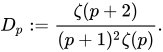
![{\displaystyle \Vert [S]\Vert _{p}=D_{p}^{1/p}n^{2+(2/p)}+O((n^{(2/p)+1}(\log n)^{2/3}(\log \log n)^{4/3}),}](https://wikimedia.org/api/rest_v1/media/math/render/svg/48754a37258b798f4072b256fb863ff7551fbd2f)
where
Factorizations
[edit]Let be an arithmetical function, and let be a set of distinct positive integers. Then the matrix is referred to as the GCD matrix on associated with . The LCM matrix on associated with is defined analogously. One may also use the notations and .


![{\displaystyle [S]_{f}}](https://wikimedia.org/api/rest_v1/media/math/render/svg/746ffae29ff76e15fe2f760e593e2ae15b4f2258)

![{\displaystyle [S]_{f}=f[S]}](https://wikimedia.org/api/rest_v1/media/math/render/svg/f33f2919c50f3f06472a6dedfa2b7362fae9ee9e)
Let be a GCD-closed set. Then
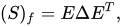
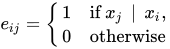
where is the matrix defined by

and is the diagonal matrix, whose diagonal elements are

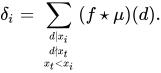
Here is the Dirichlet convolution and is the Möbius function.


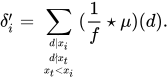
Further, if is a multiplicative function and always nonzero, then
![{\displaystyle [S]_{f}=\Lambda E\Delta ^{\prime }E^{T}\Lambda ,}](https://wikimedia.org/api/rest_v1/media/math/render/svg/05ce0593bd1a72e29cbe8fb500616e6ea9450572)
where and are the diagonal matrices, whose diagonal elements are and


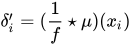
If is factor-closed, then and . [7]

References
[edit]- 1 2 Bourque, K.; Ligh, S. (1992). "On GCD and LCM matrices". Linear Algebra and Its Applications. 174: 65–74. doi:10.1016/0024-3795(92)90042-9.
- 1 2 Hong, S. (1999). "On the Bourque–Ligh conjecture of least common multiple matrices". Journal of Algebra. 218: 216–228. doi:10.1006/jabr.1998.7844.
- ↑ Smith, H. J. S. (1875). "On the value of a certain arithmetical determinant". Proceedings of the London Mathematical Society. 1: 208–213. doi:10.1112/plms/s1-7.1.208.
- ↑ Haukkanen, P.; Wang, J.; Sillanpää, J. (1997). "On Smith's determinant". Linear Algebra and Its Applications. 258: 251–269. doi:10.1016/S0024-3795(96)00192-9.
- ↑ Korkee, I.; Mattila, M.; Haukkanen, P. (2019). "A lattice-theoretic approach to the Bourque–Ligh conjecture". Linear and Multilinear Algebra. 67 (12): 2471–2487. arXiv:1403.5428. doi:10.1080/03081087.2018.1494695. S2CID 117112282.
- ↑ Merikoski, Jorma K.; Haukkanen, Pentti; Sasaki, Antonio; Tossavainen, Timo (2025). "On Generalized Eigenvalues of MAX Matrices to MIN Matrices and LCM Matrices to GCD Matrices" (PDF). Journal of Integer Sequences. 28 (7). Article 25.7.1. arXiv:2601.16626.
- 1 2 Haukkanen, P.; Toth, L. (2018). "Inertia, positive definiteness and ℓp norm of GCD and LCM matrices and their unitary analogs" (PDF). Linear Algebra and Its Applications. 558: 1–24. doi:10.1016/j.laa.2018.08.022.