


Fusion frame
 | This article has multiple issues. Please help improve it or discuss these issues on the talk page. (Learn how and when to remove these messages)
|


In mathematics, a fusion frame of a vector space is a natural extension of a frame. It is an additive construct of several, potentially "overlapping" frames. The motivation for this concept comes from the event that a signal can not be acquired by a single sensor alone (a constraint found by limitations of hardware or data throughput), rather the partial components of the signal must be collected via a network of sensors, and the partial signal representations are then fused into the complete signal.
By construction, fusion frames easily lend themselves to parallel or distributed processing[1] of sensor networks consisting of arbitrary overlapping sensor fields.
Definition
[edit]Given a Hilbert space , let be closed subspaces of , where is an index set. Let be a set of positive scalar weights. Then is a fusion frame of if there exist constants such that




where denotes the orthogonal projection onto the subspace . The constants and are called lower and upper bound, respectively. When the lower and upper bounds are equal to each other, becomes a -tight fusion frame. Furthermore, if , we can call Parseval fusion frame.[1]


Assume is a frame for . Then is called a fusion frame system for .[1]


Relation to global frames
[edit]Let be closed subspaces of with positive weights . Suppose is a frame for with frame bounds and . Let and , which satisfy that . Then is a fusion frame of if and only if is a frame of .





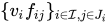
Additionally, if is a fusion frame system for with lower and upper bounds and , then is a frame of with lower and upper bounds and . And if is a frame of with lower and upper bounds and , then is a fusion frame system for with lower and upper bounds and .[2]


Local frame representation
[edit]Let be a closed subspace, and let be an orthonormal basis of . Then the orthogonal projection of onto is given by[3]



We can also express the orthogonal projection of onto in terms of given local frame of



where is a dual frame of the local frame .[1]

Fusion frame operator
[edit]Definition
[edit]Let be a fusion frame for . Let be representation space for projection. The analysis operator is defined by
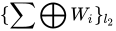


The adjoint is called the synthesis operator , defined as

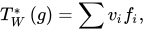
where .

The fusion frame operator is defined by[2]


Properties
[edit]Given the lower and upper bounds of the fusion frame , and , the fusion frame operator can be bounded by


where is the identity operator. Therefore, the fusion frame operator is positive and invertible.[2]

Representation
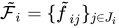
[edit]Given a fusion frame system for , where , and , which is a dual frame for , the fusion frame operator can be expressed as

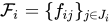

- ,

where , are analysis operators for and respectively, and , are synthesis operators for and respectively.[1]


For finite frames (i.e., and ), the fusion frame operator can be constructed with a matrix.[1] Let be a fusion frame for , and let be a frame for the subspace and an index set for each . Then the fusion frame operator reduces to an matrix, given by



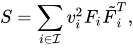
with
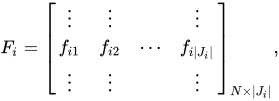
and
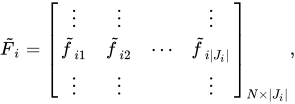
where is the canonical dual frame of .


See also
[edit]References
[edit]- 1 2 3 4 5 6 Casazza, Peter G.; Kutyniok, Gitta; Li, Shidong (2008). "Fusion frames and distributed processing". Applied and Computational Harmonic Analysis. 25 (1): 114–132. arXiv:math/0605374. doi:10.1016/j.acha.2007.10.001. S2CID 329040.
- 1 2 3 Casazza, P.G.; Kutyniok, G. (2004). "Frames of subspaces". Wavelets, Frames and Operator Theory. Contemporary Mathematics. Vol. 345. pp. 87–113. doi:10.1090/conm/345/06242. ISBN 9780821833803. S2CID 16807867.
- ↑ Christensen, Ole (2003). An introduction to frames and Riesz bases. Boston [u.a.]: Birkhäuser. p. 8. ISBN 978-0817642952.