


Free motion equation
 | This article may be too technical for most readers to understand. (May 2025) |
A free motion equation is a differential equation that describes a mechanical system in the absence of external forces, but in the presence only of an inertial force depending on the choice of a reference frame. In non-autonomous mechanics on a configuration space , a free motion equation is defined as a second order non-autonomous dynamic equation on which is brought into the form


with respect to some reference frame on . Given an arbitrary reference frame on , a free motion equation reads


where is a connection on associates with the initial reference frame . The right-hand side of this equation is treated as an inertial force.
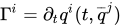
A free motion equation need not exist in general. It can be defined if and only if a configuration bundle of a mechanical system is a toroidal cylinder .

See also
[edit]References
[edit]- De Leon, M., Rodrigues, P., Methods of Differential Geometry in Analytical Mechanics (North Holland, 1989).
- Giachetta, G., Mangiarotti, L., Sardanashvily, G., Geometric Formulation of Classical and Quantum Mechanics (World Scientific, 2010) ISBN 981-4313-72-6 (arXiv:0911.0411).
 | This article about theoretical physics is a stub. You can help Wikipedia by adding missing information. |
 | This classical mechanics–related article is a stub. You can help Wikipedia by adding missing information. |