


// Workers AI · dad joke modeWhat did Fleischmannia incarnata say? "Leaf" me alone.
| Fleischmannia incarnata | |
|---|---|
 | |
Scientific classification  | |
| Kingdom: | Plantae |
| Clade: | Embryophytes |
| Clade: | Tracheophytes |
| Clade: | Angiosperms |
| Clade: | Eudicots |
| Clade: | Asterids |
| Order: | Asterales |
| Family: | Asteraceae |
| Genus: | Fleischmannia |
| Species: | F. incarnata |
| Binomial name | |
| Fleischmannia incarnata | |
| Synonyms[1] | |
| |
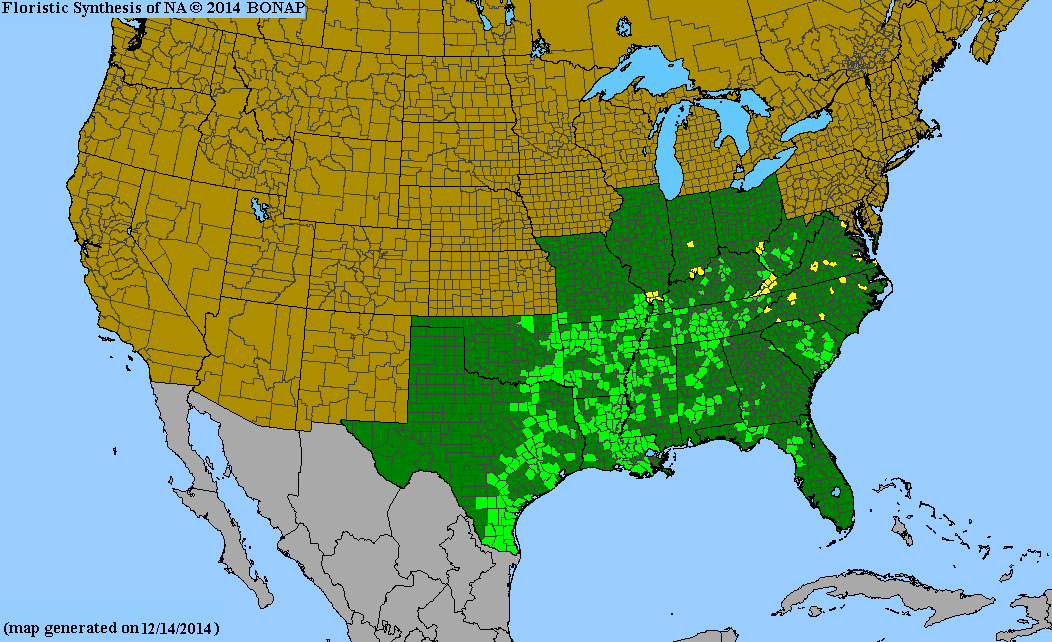
Fleischmannia incarnata, the pink slender-thoroughwort[2] or pink thoroughwort,[3] is a North American species of flowering plant in the family Asteraceae. It is native to the United States from Florida north as far as Virginia, Ohio, and Illinois, and west to Texas and Oklahoma.[2][4] It is also found in northeastern Mexico (Veracruz, Tamaulipas, Nuevo León).[5]
Fleischmannia incarnata grows in moist woodlands, thickets, marshes, and along streambanks. It is a perennial herb up to 200 cm (79 in) or 6 2/3 feet) tall. It produces numerous flower heads in a flat-topped array at the ends of the stems, each head with about 20 pink, purple, or whitish disc flowers per head but no ray flowers.[2] The plant attracts butterflies.[6]
References
[edit]- ↑ The Plant List, Fleischmannia incarnata (Walter) R.M.King & H.Rob.
- 1 2 3 Flora of North America, Fleischmannia incarnata (Walter) R. M. King & H. Robinson, 1970. Pink slender-thoroughwort
- ↑ NRCS. "Fleischmannia incarnata". PLANTS Database. United States Department of Agriculture (USDA). Retrieved 15 July 2015.
- ↑ Biota of North America Program 2014 county distribution map
- ↑ Turner, B. L. 1997. The Comps of Mexico: A systematic account of the family Asteraceae, vol. 1 – Eupatorieae. Phytologia Memoirs 11: i–iv, 1–272
- ↑ "Lady Bird Johnson Wildflower Center - The University of Texas at Austin". www.wildflower.org. Retrieved 2022-01-13.
 | This Eupatorieae article is a stub. You can help Wikipedia by adding missing information. |