


// Workers AI · dad joke modeWhat did the Fibonacci group say? We're a growing concern.
In mathematics, for a natural number , the nth Fibonacci group, denoted or sometimes , is defined by n generators and n relations:



- .





These groups were introduced by John Conway in 1965.
The group is of finite order for (order 1,8,5,11,29, respectively), and infinite order for and . The infinitude of was proved by computer in 1990.



Kaplansky's unit conjecture
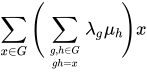
[edit]From a group and a field (or more generally a ring), the group ring is defined as the set of all finite formal -linear combinations of elements of − that is, an element of is of the form , where for all but finitely many so that the linear combination is finite. The (size of the) support of an element in , denoted , is the number of elements such that , i.e. the number of terms in the linear combination. The ring structure of is the "obvious" one: the linear combinations are added "component-wise", i.e. as , whose support is also finite, and multiplication is defined by , whose support is again finite, and which can be written in the form as .


![{\displaystyle K[G]}](https://wikimedia.org/api/rest_v1/media/math/render/svg/083a999799be375d1cbc5c62575915924775f275)


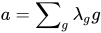





Kaplansky's unit conjecture states that given a field and a torsion-free group (a group in which all non-identity elements have infinite order), the group ring does not contain any non-trivial units – that is, if in then for some and . Giles Gardam disproved this conjecture in February 2021 by providing a counterexample.[1][2][3] He took , the finite field with two elements, and he took to be the 6th Fibonacci group . The non-trivial unit he discovered has .[1]


![{\displaystyle \alpha \in \mathbb {F} _{2}[F(2,6)]}](https://wikimedia.org/api/rest_v1/media/math/render/svg/7ef36df69c68a884a2bfde8a3352387419731560)

The 6th Fibonacci group has also been variously referred to as the Hantzsche-Wendt group, the Passman group, and the Promislow group.[1][4]
References
[edit]- 1 2 3 Gardam, Giles (2021). "A counterexample to the unit conjecture for group rings". Annals of Mathematics. 194 (3). arXiv:2102.11818. doi:10.4007/annals.2021.194.3.9. S2CID 232013430.
- ↑ "Interview with Giles Gardam". Mathematics Münster, University of Münster. Retrieved 10 March 2021.
- ↑ Klarreich, Erica. "Mathematician Disproves 80-Year-Old Algebra Conjecture". Quanta Magazine. Retrieved 13 April 2021.
- ↑ Gardam, Giles. "Kaplansky's conjectures". YouTube.
External links
[edit]- An alternative proof that the Fibonacci group F(2,9) is infinite by Derek K. Holt (PostScript file).
- "Fibonacci group". Encyclopedia of Mathematics.