


Fiber pull-out
Fiber pull-out is one of the failure mechanisms in fiber-reinforced composite materials.[1] Other forms of failure include delamination, intralaminar matrix cracking, longitudinal matrix splitting, fiber/matrix debonding, and fiber fracture.[1] The cause of fiber pull-out and delamination is weak bonding.[2]
Work for debonding, [3]
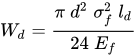
where
- is fiber diameter
- is failure strength of the fiber
- is the length of the debonded zone
- is fiber modulus


In ceramic matrix composite material this mechanism is not a failure mechanism, but essential for its fracture toughness,[4] which is several factors above that of conventional ceramics.
The figure is an example of how a fracture surface of this material looks like. The strong fibers form bridges over the cracks before they fail at elongations around 0.7%, and thus prevent brittle rupture of the material at 0.05%, especially under thermal shock conditions.[5][page needed] This allows using this type of ceramics for heat shields applied for the re-entry of space vehicles, for disk brakes and slide bearing components.
References
[edit]- 1 2 WJ Cantwell, J Morton (1991). "The impact resistance of composite materials -- a review". Composites. 22 (5): 347–62. doi:10.1016/0010-4361(91)90549-V.
- ↑ Serope Kalpakjian, Steven R Schmid. "Manufacturing Engineering and Technology". 6th Ed. Prentice Hall, Inc. 2009, p. 223. ISBN 0136081681
- ↑ PWR Beaumont. "Fracture mechanisms in fibrous composites". Fracture Mechanics, Current Status, Future Prospects. Edited by RA Smith. Pergamon Press: 1979. p211-33 in WJ Cantwell, J Morton (1991). "The impact resistance of composite materials -- a review". Composites. 22 (5): 347–62. doi:10.1016/0010-4361(91)90549-V.
- ↑ V. Bheemreddy et al. "Modeling of fiber pull-out in continuous fiber reinforced ceramic composites using finite element method and artificial neural networks," Computational Materials Science, Vol. 79, pp.663-676, 2013.
- ↑ W. Krenkel, ed.:Ceramic Matrix Composites, Wiley-VCH, Weinheim, 2008, doi:10.1002/9783527622412 ISBN 978-3-527-31361-7