


// Workers AI · dad joke modeWhat did factor shares say to each other? Let's split.
 | This article needs more citations. (February 2022) |
In macroeconomics, factor shares are the share of production given to the factors of production, usually capital and labor. This concept uses the methods and fits into the framework of neoclassical economics.
Derivation
[edit]In exogenous growth models, the production function can be represented by:[1]
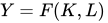
with Y total production, K capital, and L labor. So a representative agent will attempt to maximize a profit function:[2]

where is the cost to the firm, r the rental rate of capital, w the wage rate for labor, and P is the price of the output.

As in microeconomics supply and demand models, first-order conditions that the derivative of this function with respect to capital and labor will be zero at the functions maximum. Thus (assuming P = 1) we can calculate the wages and the rental rate of capital:
and .
![{\displaystyle w=D_{L}[F(K,L)]\,}](https://wikimedia.org/api/rest_v1/media/math/render/svg/b461586bd18f6a15d4ed4b7a6177bd59faca3411)
![{\displaystyle r=D_{K}[F(K,L)]\,}](https://wikimedia.org/api/rest_v1/media/math/render/svg/8a4233f2f5f056747a396fd1179fd6defc1fe846)
Now we can write the expenditure allocated to labor as
![{\displaystyle wL=D_{L}[F(K,L)]*L\,}](https://wikimedia.org/api/rest_v1/media/math/render/svg/482d15972e097b18365b9f6dc3ac1acbc689a020)
and to capital as
![{\displaystyle rK=D_{K}[F(K,L)]*K\,}](https://wikimedia.org/api/rest_v1/media/math/render/svg/9b7d3fa265291e4f5c7e02379e355915f5318e14)
So the factor share devoted to labor is:
![{\displaystyle wL/Y=D_{L}[F(K,L)]*L/F(K,L)\,}](https://wikimedia.org/api/rest_v1/media/math/render/svg/8487303670bfdbc98aa38841c55facb11bf6ce62)
and the factor share devoted to capital is:
![{\displaystyle rK/Y=D_{K}[F(K,L)]*K/F(K,L)\,}](https://wikimedia.org/api/rest_v1/media/math/render/svg/3f54cc0220d142fecd8055490d7030c69b6fb5ac)
References
[edit]- ↑ "What is the Solow Growth Model?". Corporate Finance Institute. Retrieved 22 October 2021.
- ↑ S. Bellas, Allen, "Profit Maximization and Input Demand", Economics 352: Intermediate Microeconomics Chapter 9 (PDF), Metropolitan State University, p. 12