


Fσ set
In general topology, an Fσ set (pronounced F-sigma set) is a countable union of closed sets. The notation originated in French with F for fermé (French: closed) and σ for somme (French: sum, union).[1]
The complement of an Fσ set is a Gδ set.[1]
Fσ is the same as in the Borel hierarchy.

Examples
[edit]Each closed set is an Fσ set.
The set of rationals is an Fσ set in . More generally, any countable set in a T1 space is an Fσ set, because every singleton is closed.


The set of irrationals is not an Fσ set.

In metrizable spaces, every open set is an Fσ set.[2]
The intersection or union of finitely many Fσ sets is an Fσ set.
Assuming the Axiom of countable choice, the union of countably many Fσ sets is an Fσ set.
The set of all points in the Cartesian plane such that is rational is an Fσ set because it can be expressed as the union of all the lines passing through the origin with rational slope:


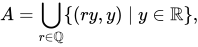
where is the set of rational numbers, which is a countable set.
See also
[edit]- Gδ set — the dual notion.
- Borel hierarchy
- P-space, any space having the property that every Fσ set is closed
References
[edit]- 1 2 Stein, Elias M.; Shakarchi, Rami (2009), Real Analysis: Measure Theory, Integration, and Hilbert Spaces, Princeton University Press, p. 23, ISBN 9781400835560.
- ↑ Aliprantis, Charalambos D.; Border, Kim (2006), Infinite Dimensional Analysis: A Hitchhiker's Guide, Springer, p. 138, ISBN 9783540295877.
| Lightface | Boldface | ||
|---|---|---|---|
| Σ0 0 = Π0 0 = Δ0 0 (sometimes the same as Δ0 1) |
Σ0 0 = Π0 0 = Δ0 0 (if defined) | ||
| Δ0 1 = recursive |
Δ0 1 = clopen | ||
| Σ0 1 = recursively enumerable |
Π0 1 = co-recursively enumerable |
Σ0 1 = G = open |
Π0 1 = F = closed |
| Δ0 2 |
Δ0 2 | ||
| Σ0 2 |
Π0 2 |
Σ0 2 = Fσ |
Π0 2 = Gδ |
| Δ0 3 |
Δ0 3 | ||
| Σ0 3 |
Π0 3 |
Σ0 3 = Gδσ |
Π0 3 = Fσδ |
| ⋮ | ⋮ | ||
| Σ0 <ω = Π0 <ω = Δ0 <ω = Σ1 0 = Π1 0 = Δ1 0 = arithmetical |
Σ0 <ω = Π0 <ω = Δ0 <ω = Σ1 0 = Π1 0 = Δ1 0 = boldface arithmetical | ||
| ⋮ | ⋮ | ||
| Δ0 α (α recursive) |
Δ0 α (α countable) | ||
| Σ0 α |
Π0 α |
Σ0 α |
Π0 α |
| ⋮ | ⋮ | ||
| Σ0 ωCK 1 = Π0 ωCK 1 = Δ0 ωCK 1 = Δ1 1 = hyperarithmetical |
Σ0 ω1 = Π0 ω1 = Δ0 ω1 = Δ1 1 = B = Borel | ||
| Σ1 1 = lightface analytic |
Π1 1 = lightface coanalytic |
Σ1 1 = A = analytic |
Π1 1 = CA = coanalytic |
| Δ1 2 |
Δ1 2 | ||
| Σ1 2 |
Π1 2 |
Σ1 2 = PCA |
Π1 2 = CPCA |
| Δ1 3 |
Δ1 3 | ||
| Σ1 3 |
Π1 3 |
Σ1 3 = PCPCA |
Π1 3 = CPCPCA |
| ⋮ | ⋮ | ||
| Σ1 <ω = Π1 <ω = Δ1 <ω = Σ2 0 = Π2 0 = Δ2 0 = analytical |
Σ1 <ω = Π1 <ω = Δ1 <ω = Σ2 0 = Π2 0 = Δ2 0 = P = projective | ||
| ⋮ | ⋮ | ||
 | This topology-related article is a stub. You can help Wikipedia by adding missing information. |