


Extensional viscosity
Extensional viscosity (also known as elongational viscosity) is a viscosity coefficient when the applied stress is extensional stress.[1] It is often used for characterizing polymer solutions. Extensional viscosity can be measured using rheometers that apply extensional stress. Acoustic rheometer is one example of such devices.
Extensional viscosity is defined as the ratio of the normal stress difference to the rate of strain. For uniaxial extension along direction :[2]

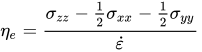
where
- is the extensional viscosity or elongational viscosity
- is the normal stress along direction n.
- is the rate of strain:


The ratio between the extensional viscosity and the dynamic viscosity is known as Trouton's Ratio, . For a Newtonian Fluid, the Trouton ratio equals three.


See also
[edit]References
[edit]
 | This fluid dynamics–related article is a stub. You can help Wikipedia by adding missing information. |