


Exponentially equivalent measures
In mathematics, exponential equivalence of measures is how two sequences or families of probability measures are "the same" from the point of view of large deviations theory.
Definition
[edit]Let be a metric space and consider two one-parameter families of probability measures on , say and . These two families are said to be exponentially equivalent if there exist


- a one-parameter family of probability spaces ,
- two families of -valued random variables and ,
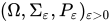


such that
- for each , the -law (i.e. the push-forward measure) of is , and the -law of is ,
- for each , " and are further than apart" is a -measurable event, i.e.



- for each ,

The two families of random variables and are also said to be exponentially equivalent.
Properties
[edit]The main use of exponential equivalence is that as far as large deviations principles are concerned, exponentially equivalent families of measures are indistinguishable. More precisely, if a large deviations principle holds for with good rate function , and and are exponentially equivalent, then the same large deviations principle holds for with the same good rate function .

References
[edit]- Dembo, Amir; Zeitouni, Ofer (1998). Large deviations techniques and applications. Applications of Mathematics (New York) 38 (Second ed.). New York: Springer-Verlag. pp. xvi+396. ISBN 0-387-98406-2. MR 1619036. (See section 4.2.2)