


Exponential dispersion model
In probability and statistics, the class of exponential dispersion models (EDM), also called exponential dispersion family (EDF), is a set of probability distributions that represents a generalisation of the natural exponential family.[1][2][3] Exponential dispersion models play an important role in statistical theory, in particular in generalized linear models because they have a special structure which enables deductions to be made about appropriate statistical inference.
Definition
[edit]Univariate case
[edit]There are two versions to formulate an exponential dispersion model.
Additive exponential dispersion model
[edit]In the univariate case, a real-valued random variable belongs to the additive exponential dispersion model with canonical parameter and index parameter , , if its probability density function can be written as




Reproductive exponential dispersion model
[edit]The distribution of the transformed random variable is called reproductive exponential dispersion model, , and is given by

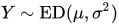

with and , implying . The terminology dispersion model stems from interpreting as dispersion parameter. For fixed parameter , the is a natural exponential family.




Multivariate case
[edit]In the multivariate case, the n-dimensional random variable has a probability density function of the following form[1]


where the parameter has the same dimension as .

Properties
[edit]Cumulant-generating function
[edit]The cumulant-generating function of is given by
![{\displaystyle K(t;\mu ,\sigma ^{2})=\log \operatorname {E} [e^{tY}]={\frac {A(\theta +\sigma ^{2}t)-A(\theta )}{\sigma ^{2}}}\,\!,}](https://wikimedia.org/api/rest_v1/media/math/render/svg/36a82796d591516d007584869950a89c1dd68d87)
with
Mean and variance
[edit]Mean and variance of are given by
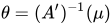
![{\displaystyle \operatorname {E} [Y]=\mu =A'(\theta )\,,\quad \operatorname {Var} [Y]=\sigma ^{2}A''(\theta )=\sigma ^{2}V(\mu )\,\!,}](https://wikimedia.org/api/rest_v1/media/math/render/svg/e2fa7b23c753dd132adf906e6d07992332b6eac5)
with unit variance function .

Reproductive
[edit]If are i.i.d. with , i.e. same mean and different weights , the weighted mean is again an with

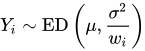


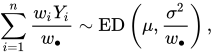
with . Therefore are called reproductive.


Unit deviance
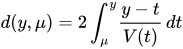
[edit]The probability density function of an can also be expressed in terms of the unit deviance as


where the unit deviance takes the special form or in terms of the unit variance function as .

Examples
[edit]Many very common probability distributions belong to the class of EDMs, among them are: normal distribution, binomial distribution, Poisson distribution, negative binomial distribution, gamma distribution, inverse Gaussian distribution, and Tweedie distribution.
References
[edit]- 1 2 Jørgensen, B. (1987). Exponential dispersion models (with discussion). Journal of the Royal Statistical Society, Series B, 49 (2), 127–162.
- ↑ Jørgensen, B. (1992). The theory of exponential dispersion models and analysis of deviance. Monografias de matemática, no. 51.
- ↑ Marriott, P. (2005) "Local Mixtures and Exponential Dispersion Models" pdf